
The CIC34 is the community interest company report that every Community Interest Company (CIC) must deliver to Companies House each year, together with its annual accounts. Companies House passes it to the Regulator of Community Interest Companies and puts it on the public record. It shows that the company is still working for the community it was set up to serve. This guide explains what goes in the report, when it is due, what it costs and how to file it, and how Tax Optimiser fits in.
What is a CIC34 report?
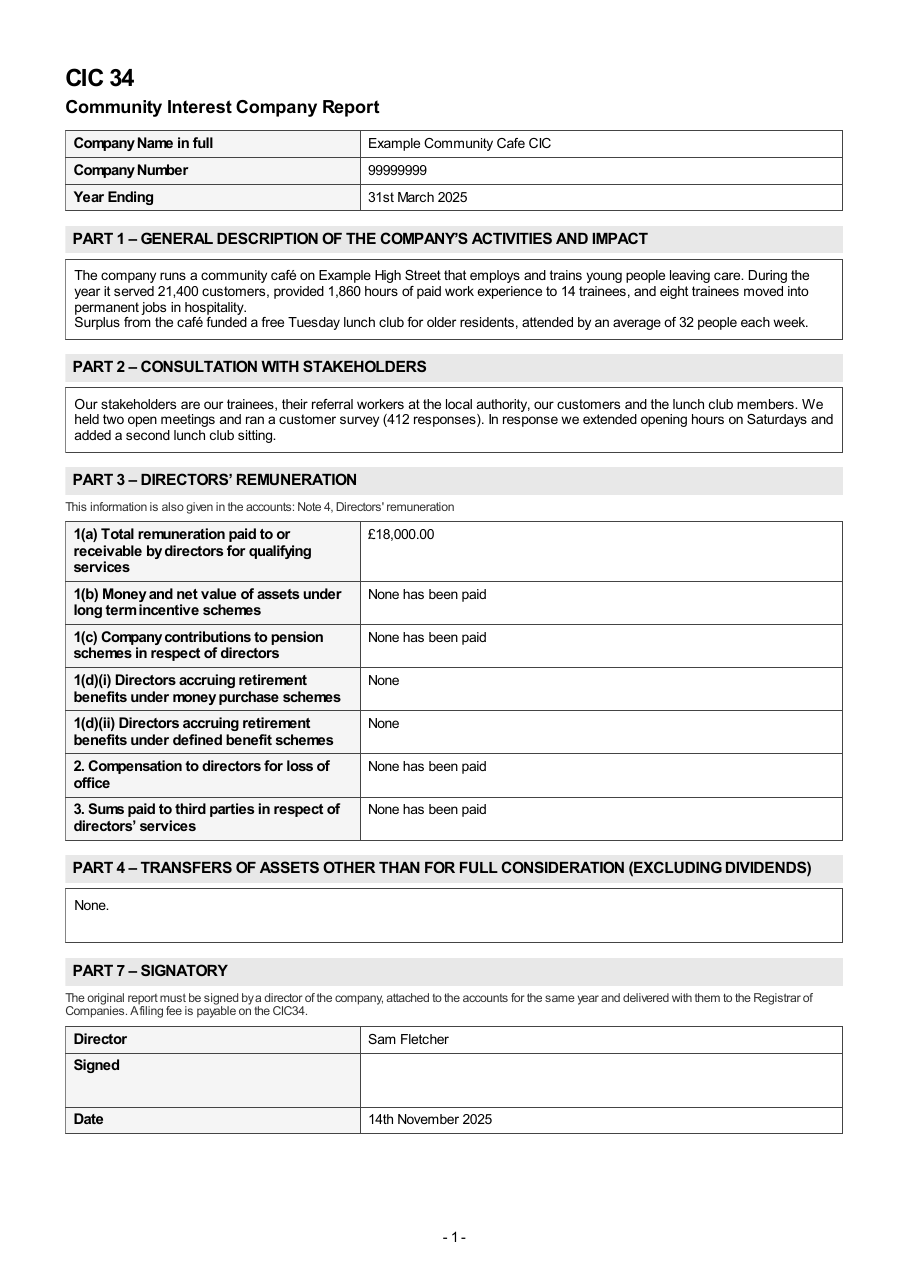
The CIC34 is a short annual report, signed by a director, that explains how a CIC has benefited the community during the financial year. It sits alongside the accounts: the accounts show the money, the CIC34 shows the community benefit and confirms the asset lock has been respected. It is set out in seven parts:
- Activities and impact — what the company did in the year and how the community benefited.
- Consultation with stakeholders — who is affected by the company’s work, how they were consulted and what changed as a result. If there was no consultation, the report must say so.
- Directors’ remuneration — pay, pension contributions, compensation for loss of office and payments to third parties for directors’ services.
- Transfers of assets other than for full consideration — anything given away or sold below market value, and to whom.
- Dividends — only for a CIC limited by shares that declared or proposed a dividend.
- Performance-related interest — only if a loan or debenture paid interest linked to the company’s profits or turnover.
- Signatory — the director signing the report, and the date.
Most CICs file the simplified CIC34. The detailed version is needed only when Part 5 or Part 6 applies.
When is the CIC34 due?
The CIC34 is due at the same time as the accounts, because the two are delivered together. For a private company that is normally 9 months after the end of the accounting period (a company’s first accounts can have a longer deadline). Companies House charges a late filing penalty when the accounts are late, so leave enough time to write and sign the report before the deadline.
How much does it cost to file a CIC34?
Companies House’s current fee is £15 for the CIC report delivered with the accounts. Online it is paid by debit or credit card. By post it is paid by cheque or postal order made payable to Companies House. Ordinary company accounts are free to file, so this fee is the one cost a CIC has that other companies do not.
How to file CIC accounts and the CIC34
File the accounts and the CIC34 together, either through Companies House’s own CIC online service or by post.
Online: File your annual CIC report and accounts
- Approve the accounts at a board meeting. Companies House requires the directors to approve accounts before they are filed.
- Prepare the CIC34 and have a director sign it.
- Have ready a Companies House account, the company number, the company authentication code and a debit or credit card.
- Go to Companies House’s File your annual CIC report and accounts service and follow the steps for full accounts. Package accounts (a ZIP file holding the accounts and report) can also be filed there, but only if your software produces that package.
- Pay the fee. Once accepted, the report and accounts appear on the company’s public record.
By post
Print the accounts, have a director sign the original CIC34, and send both together with the fee to Companies House, Crown Way, Cardiff CF14 3UZ. Never send the CIC34 on its own: Companies House expects it with the accounts for the same year.
Don’t use the ordinary accounts routes for a CIC. Companies House’s standard WebFiling accounts journey has no place for the CIC34, and accounts a CIC files through software without the report are rejected (reject code 2422).
Why can’t accounts software file my CIC accounts?
Because Companies House only accepts a CIC’s accounts from software as package accounts: the accounts and the CIC34 delivered together in one ZIP file. The normal software filing of a single iXBRL accounts document cannot carry the report, so Companies House rejects it. Tax Optimiser does not file package accounts, so its File with Companies House screen will not submit a CIC’s accounts. It stops before the submission is sent, so no submission is wasted. Prepare everything in Tax Optimiser, then file through the CIC online service or by post.
What Tax Optimiser does for a CIC
Tax Optimiser prepares a CIC’s accounts and CIC34 and files its Corporation Tax return. You file the accounts and report with Companies House yourself.
- Corporation Tax return. A CIC files a normal CT600, filed with HMRC from Tax Optimiser as usual. A CIC is not a charity, so there is no CT600E and the Corporation Tax company type stays Not applicable.
- Accounts. A small CIC can use micro-entity (FRS 105) or small-company (FRS 102 Section 1A) accounts. See the statutory accounts guide.
- CIC34. Open the accounting period, go to File with Companies House and choose Prepare CIC34 report. The company name, number and year end come from the period, so they match the accounts.

Complete Parts 1 to 7 and save. Then choose Download CIC34 (PDF), print it and have a director sign it.

The PDF follows the order of the Regulator’s form and writes dates in full, as the Regulator asks:
For flagging the organisation as a CIC and a part-by-part guide to the form, see Community Interest Companies: the CT600 and the CIC34 report.
What changes in April 2028?
Companies House has said that from 1 April 2028 all companies must file their accounts using commercial software, and its own online services and paper filing will close for accounts. CICs will then need software that files package accounts with the CIC34. Until then, the CIC online service and post remain open.
Common questions
Can a CIC file micro-entity accounts?
Yes. A CIC that meets the micro-entity size limits can prepare FRS 105 accounts, and the copy filed at Companies House can leave out the profit and loss account. The CIC34 still has to be filed with them, and it is where the company reports its community activity.
Does the CIC34 go to HMRC?
No. The CIC34 goes to Companies House with the accounts, and Companies House passes it to the CIC Regulator. HMRC only receives the Corporation Tax return (CT600) and its accounts and computations.
Who signs the CIC34?
A director of the company signs and dates it in Part 7. On the paper route the original signed report is sent to Companies House.
What if we did not consult our stakeholders this year?
Say so. Part 2 must either describe the consultation or state that there has been no stakeholder consultation. Leaving it blank is not enough.
Does a dormant CIC need to file a CIC34?
Yes. A CIC must deliver a community interest company report with its accounts every year, including dormant accounts. The report can be brief and explain that the company was dormant.
Is a CIC a charity for Corporation Tax?
No. A CIC is taxed as an ordinary company: it pays Corporation Tax at the normal rates, files a normal CT600 and cannot claim charitable exemption, even if its aims are charitable.
What does Companies House reject code 2422 mean for a CIC?
It means the company is a CIC and its accounts arrived without the CIC34. Companies House needs the two together. File them through the CIC online service or by post, or as package accounts from software that supports them.
Where do I find the company authentication code?
It is the six-character code Companies House posts to the company’s registered office address. If it has been lost, request a new one from Companies House; it is sent by post, so allow a few days before the filing deadline.
Related: Community Interest Companies: the CT600 and the CIC34 report · Statutory accounts · iXBRL package accounts · Corporation Tax: getting started · Corporation Tax for charities and CASCs (CT600E).
