
A company that is still developing its product, and has not started trading, has no trade to make a loss in. That would normally rule out the payable R&D tax credit, because the credit is paid in exchange for a trading loss. An election under section 1045 of the Corporation Tax Act 2009 fixes this: the company’s qualifying R&D expenditure, with its additional deduction, is treated as a trading loss of the period, and that loss can be surrendered for the credit.
This article shows how to put a s1045 election through the computation and the Company Tax Return (CT600) in Tax Optimiser.
The short version: set every P&L line to Not a trade, enter the R&D claim as usual, and tick Pre-trading election (CTA 2009 s1045) on R & D Expenditure → R&D Relief Entry. Box 780 then shows a trading loss equal to box 660, which you surrender on the SME credit tab.
What the election does
Without an election, costs incurred before a trade starts are not deducted in the period they are paid. They are normally treated as incurred on the day the trade begins, and relieved then.
With a s1045 election, the qualifying R&D expenditure of the period is instead treated as a trading loss now. The loss is the enhanced expenditure: the qualifying expenditure plus the additional deduction. For expenditure from 1 April 2023 that is 186% of the qualifying expenditure (100% plus the 86% additional deduction).
| Worked example | Amount | Box |
|---|---|---|
| Qualifying R&D expenditure | 20,000 | 659 and L166 |
| Additional deduction (86%) | 17,200 | |
| Enhanced expenditure, treated as a trading loss | 37,200 | 660 and 780 |
| Payable credit at 14.5% of the loss surrendered | 5,394 | L170 and 875 |
Only the R&D expenditure is covered. The company’s other costs before trading starts, such as insurance or professional fees that are not part of the claim, stay as pre-trading expenditure and get no relief on this return.
Who can use it
The election belongs to the SME R&D scheme. For accounting periods beginning on or after 1 April 2024 that means ERIS, the relief for loss-making R&D-intensive SMEs, so box 653 has to apply to the company. Companies in the merged RDEC scheme do not need a trading loss to be paid their credit, so they do not use this election. The schemes are compared in CT600L explained: R&D expenditure credit, box by box.
Whether a company has started trading, and whether its expenditure qualifies, are questions of fact for you and your adviser. Tax Optimiser does not decide them.
Making the election with HMRC
The election is not part of the CT600. It is made to HMRC in writing, and it must be made within two years of the end of the accounting period it is for. Ticking the box in Tax Optimiser sets the figures on the computation and return; it does not send the election.
The usual R&D paperwork still applies. HMRC must have the additional information form before, or on the same day as, the return, and a claim notification form where one is needed, or the claim is removed.
Step by step in Tax Optimiser
1. Take the P&L out of the trade
Open the Corp Tax workspace and go to the Profit & Loss section. Set the type of every line to Not a trade. The income and costs stay in the accounts, but they leave the trading result, so the only trading loss on the return is the one the election creates.
Lines typed Not a trade are left out of the return altogether. Check that none of the income is taxable in the period: a grant, bank interest or other investment income can be. Interest belongs in the non-trade sections, not here.
2. Enter the claim and tick the election
Go to R & D Expenditure → R&D Relief Entry:
- Enter the Qualifying R&D expenditure (box 659).
- Enter the Additional deduction: the uplift only, 86% of the qualifying expenditure.
- Check the derived Enhanced expenditure (box 660). This is the loss the election will create.
- Tick Pre-trading election (CTA 2009 s1045).
- Complete the claim details: R&D-intensive SME (box 653), and the claim notification and additional information form boxes (656 and 657).

3. Claim the payable credit
Go to the SME credit tab:
- Enter the qualifying expenditure again in L166. It must equal box 659.
- Enter the PAYE and NIC figures for the cap in L168 and L169, or tick the exception in L167 if it applies.
- Enter the payable credit in L170: 14.5% of the loss you are surrendering.
- Enter that loss in Trading loss surrendered for this credit. It cannot be more than the enhanced expenditure.
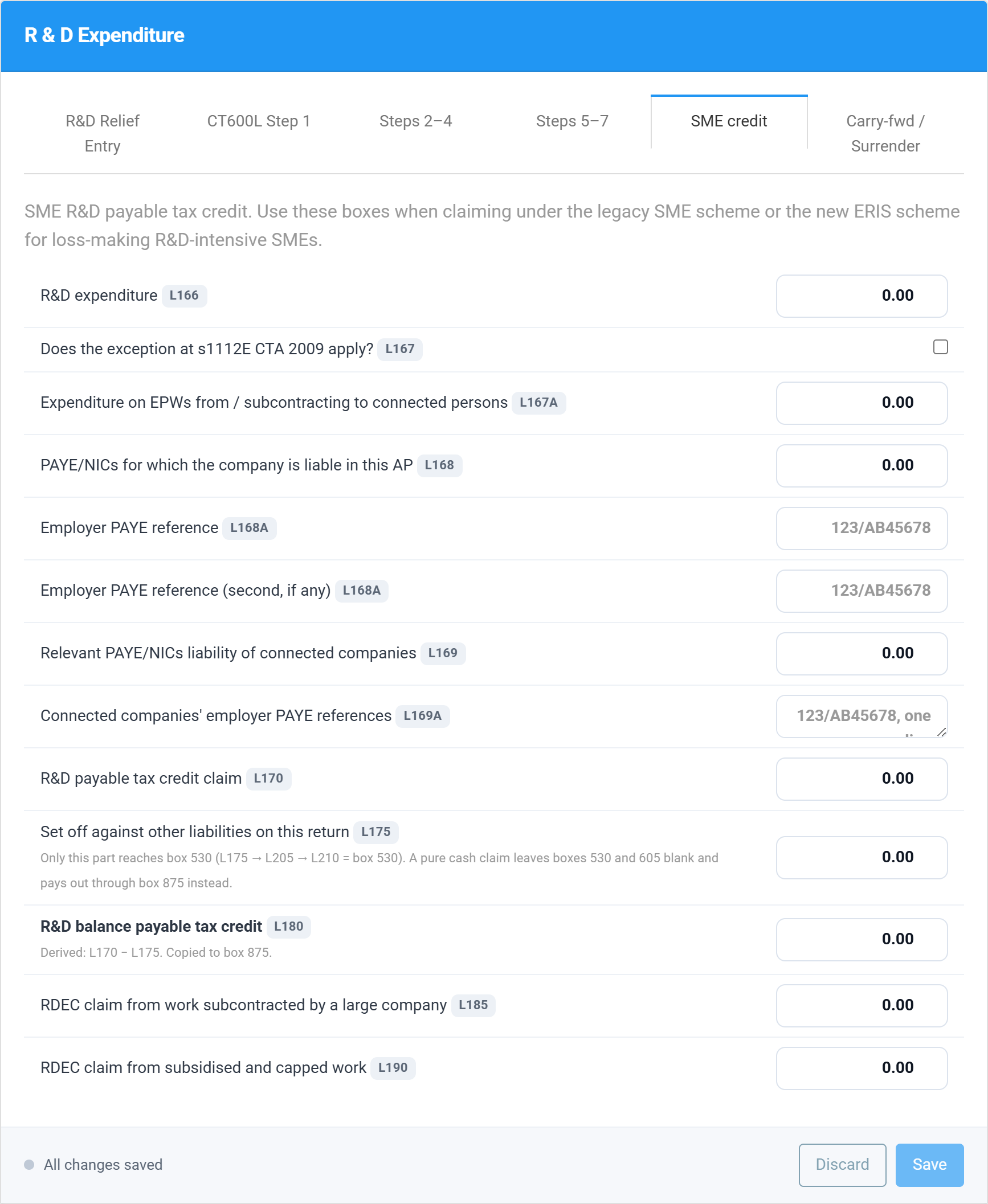
The surrendered loss comes off the loss carried forward. Surrender all of it and nothing is carried forward; surrender part and the rest stays as a loss of the period.
4. Check the result
- Computation, Accounts Adjustments page: the costs are added back as Pre-trading expenditure, then two rows are deducted: Qualifying R&D expenditure treated as a trading loss (CTA 2009 s1045) and the additional deduction. Together they equal box 660.
- CT600 Boxes: box 659 is the qualifying expenditure, box 660 the enhanced expenditure, box 780 the trading loss (the same figure as box 660 in whole pounds), box 142 is ticked for the CT600L, and box 875 is the payable credit.
- Losses: the loss surrendered is shown as Loss surrendered for R&D tax credit.
Add the company’s bank details for the repayment as described in Repayments on the CT600.
A period of account longer than 12 months
A long period is split into two returns, and the election is ticked for each return separately, using the return picker at the top of the R & D Expenditure section. Each return’s loss is its own enhanced expenditure.
- A return with no qualifying R&D expenditure has no election and no trading loss. With every line typed Not a trade its box 780 is blank, and nothing is carried forward from it.
- Leave Deduction for one return only on Accounting Adjustments empty. An amount there would create a trading loss in one return and a trading profit in the other.
See Long periods of account for how the two returns work.
Messages you may see
| Message | What to do |
|---|---|
| A pre-trading election is only for a company that has not started trading, but some P&L lines are still typed as Trade | Set the remaining lines to Not a trade on the Profit & Loss section, or untick the election if the company is trading. |
| The pre-trading election is ticked but there is no R&D claim to treat as a trading loss | Enter the qualifying expenditure (box 659) and the additional deduction for that return, or untick the election. |
| The loss surrendered cannot exceed the enhanced R&D expenditure | Reduce the loss surrendered to box 660 or less, and box L170 to 14.5% of it. |
The calculation also shows two reminders that do not stop you filing: one that the election is made to HMRC separately, and one listing the income and costs left out of the return.
When the company starts trading
Expenditure covered by a s1045 election has already been relieved, so it cannot be claimed again as pre-trading expenditure when the trade starts. The other pre-trading costs can normally be claimed in that first trading period. Type the P&L lines back to Trade from the period in which trading begins, and leave the election unticked.
Frequently asked questions
Can I claim an R&D tax credit before my company starts trading?
Yes, if the company is in the SME scheme (ERIS for periods beginning on or after 1 April 2024) and elects under section 1045 CTA 2009. The election treats the enhanced R&D expenditure as a trading loss, which can be surrendered for the payable credit.
How much is the loss under a s1045 election?
186% of the qualifying R&D expenditure for expenditure from 1 April 2023: the expenditure itself plus the 86% additional deduction. In Tax Optimiser it is the figure in box 660.
Does ticking the box send the election to HMRC?
No. The tick box only sets the figures on the computation and the CT600. The election is made to HMRC in writing, within two years of the end of the accounting period.
Why do I have to set my P&L lines to Not a trade?
Because the company has no trade yet. Lines left as Trade would be added to or taken off the loss the election creates, so the return would show the wrong trading loss. Tax Optimiser stops you filing until they are changed.
What happens to my other costs before trading starts?
They are not relieved on this return. Pre-trading costs are normally treated as incurred on the day the trade starts and claimed in that period.
Is box 780 left blank when there is no R&D in a period?
Yes. A company that is not trading and has no election for the period has no trading loss, so box 780 is blank and nothing is carried forward.
Can I carry the loss forward instead of surrendering it?
You choose how much to surrender. Any part you do not surrender stays as a loss of the period and is shown as carried forward. Take advice on how that loss can be used before the trade starts.
Do I still need the additional information form?
Yes. HMRC must receive it before, or on the same day as, the Company Tax Return, or the claim is removed.
Related: CT600L explained: R&D expenditure credit, box by box and Trading losses carried forward.
