
The Additional Information (SA101) page is the return’s catch-all for the less common entries: other UK income and life-insurance gains, share schemes and employment lump sums, other tax reliefs, the age-related Married Couple’s Allowance, pension savings charges, and tax avoidance scheme disclosures. HMRC’s schema is strict about the shape of these boxes, so the page checks formats, ranges and pairings as you type.
Other UK income
Gilt and other interest (boxes 1 to 3) is entered gross with its tax credited. Stock dividends and bonus issues (boxes 12 and 13) join the dividend income. Post-cessation receipts in box 14 are not taxed in this year: HMRC assesses them through the year named in box 15, which must be completed with it — the two boxes are a pair and the page says so.
Life-insurance gains and top-slicing relief
Chargeable event gains (boxes 4, 6 and 8, with the years each policy has run in boxes 5, 7 and 9) are taxed as savings income beneath dividends, and the calculation works out top-slicing relief the way HMRC does — comparing the tax with the gains on top against the tax on the annualised slice, with the Personal Allowance recomputed for the slice. The 20% notional tax on UK policy gains (box 4) and the tax treated as paid in box 10 are repayable credits. Where no number of years is entered the gain is treated as a one-year slice, and HMRC rejects a gain with no years and no box 1A figure when relief could apply — the calculation warns before that happens. Deficiency relief (box 11) gives 20% on the part above the basic-rate limit.
Share schemes and lump sums
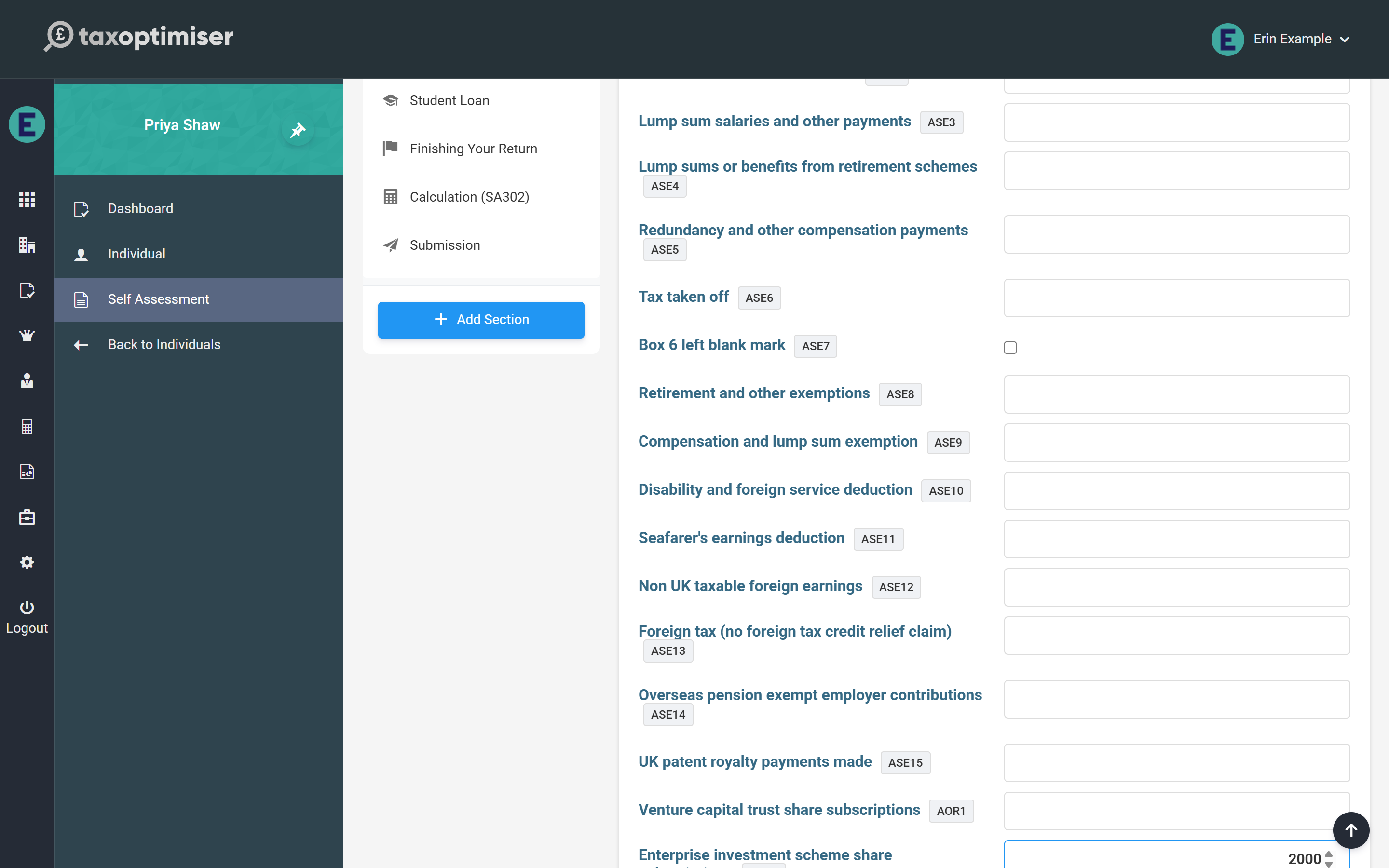
Enter the taxable amounts in boxes 3 to 5; the exemption boxes 8 to 10 are for information and are not deducted again, so the figures in 3 to 5 should already be net of any exemption. Seafarers’ and foreign-earnings deductions are taken from income. Boxes 1, 3 and 4 of the pension-related group are information only and the hints say so.
Other tax reliefs
Qualifying loan interest, annuities and the investment reliefs: EIS (30%), SEIS (50%), VCT (30% for 2025-26, 20% from 6 April 2026) and Community Investment Tax Relief, each a reduction capped at the tax charged. Payments to trade unions and friendly societies (box 4) are entered net: HMRC deducts the gross and charges basic-rate tax on it, as the hint explains.
Married Couple’s Allowance
The age-related allowance (a spouse or civil partner born before 6 April 1935 — box 2 is rejected with any later date) is laid out in three groups: the higher earner’s claim (boxes 1 to 5), the lower earner’s half or full-transfer claim (boxes 6 to 8, exactly one of 6 and 7), and the boxes both complete (9 to 11). Only one side can be claimed on a return, and the claim needs the spouse’s name in box 1, not just the date of birth. The income taper and transfer options are calculated automatically.
Pension savings charges
The annual allowance charge (boxes 8 to 11) is taxed as the top slice of the client’s income at the non-savings rates (Scottish rates for a Scottish taxpayer), with the Gift Aid-extended band but no unused Personal Allowance, and scheme pays (box 11) comes off it — HMRC requires box 11 to be less than box 10, and the scheme reference in box 12 in its PSTR format. The overseas transfer charge (25% of box 11.1 less 11.2), unauthorised payment charges (40% of boxes 13 and 14 plus the 15% surcharge on box 14, less box 15) and the short service refund charge (20% on the first £20,000 and 50% above, less box 18) are all calculated. Pension charges appear on their own line of the statement, join the balancing payment, and are left out of the payments on account — confirmed against HMRC’s test service.
Formats HMRC checks
Tax years are entered as 2024-25 (two consecutive years), scheme references in their fixed formats, and the tax avoidance scheme reference number as eight digits. The page shows the example as a placeholder and warns when the entry does not match; the pre-flight checks refuse the return on a mismatch, because HMRC would.
