
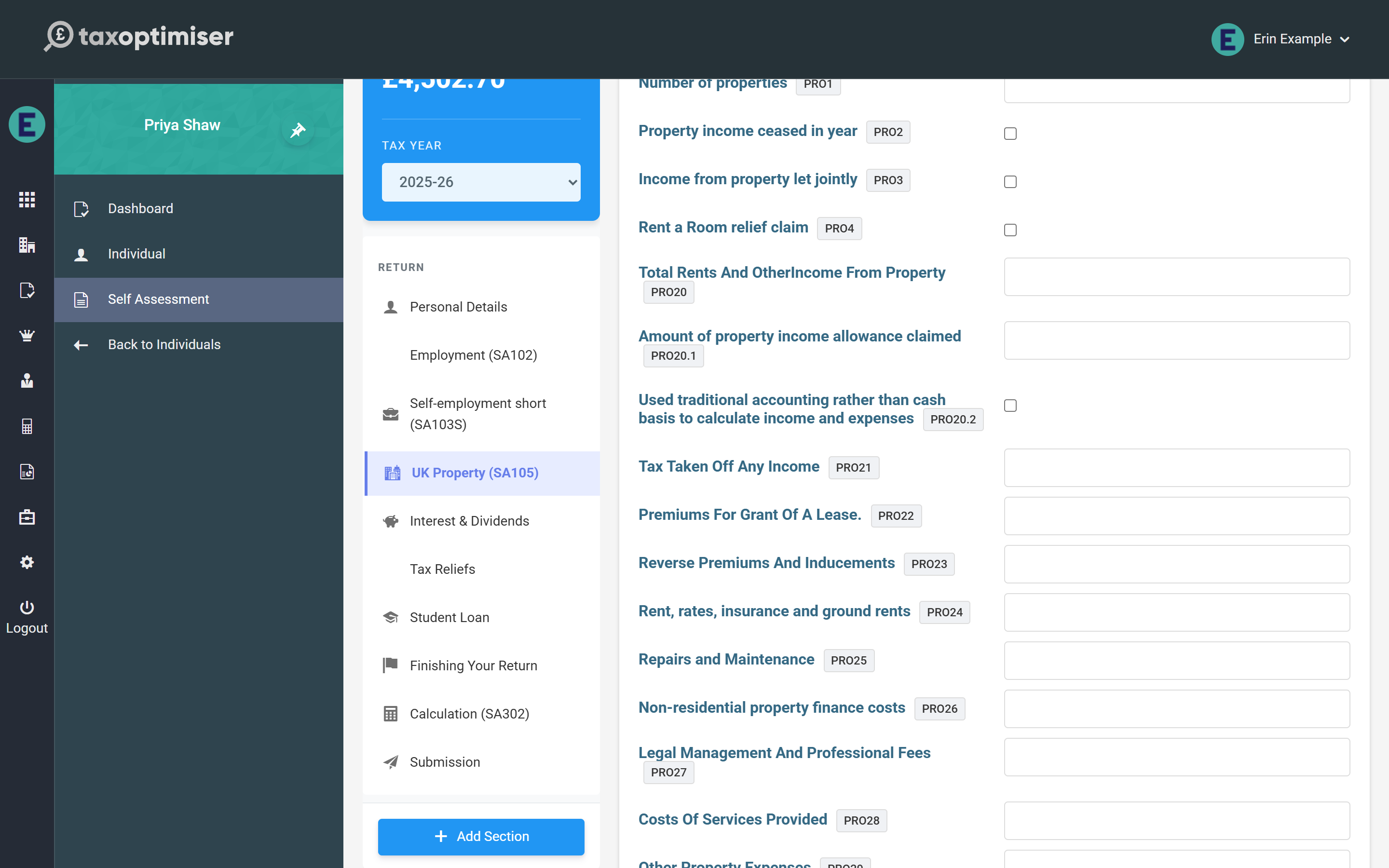
The UK Property (SA105) page follows the paper form: the number of properties and the about-the-business ticks, rents and other income, the expense categories, the adjustments, and the adjusted and taxable profit or loss for the year. Furnished holiday lettings no longer have their own boxes for 2025-26 and are entered with the other property income.
About the properties
- Number of properties (box 1) — a whole number from 1 to 99, counting every UK property let in the year, including a room in the client’s own home.
- Ceased (box 2) — tick when the whole property business stopped in the year: unused finance costs and losses are then not carried forward past the cessation.
- Jointly let (box 3) — enter the client’s share only, not the whole property’s figures.
- Rent a Room (box 4) — tick only when the receipts are within the £7,500 limit (£3,750 if shared) and the client wants them exempt, and leave every income, expense and profit box blank. The alternative method — deducting the exempt amount in box 37 instead of expenses — cannot be used alongside the box 4 claim, and the page warns if both are keyed.
Income, the property allowance and the cash basis
Rents and other receipts go in box 20, with lease premiums (box 22) and reverse premiums (box 23) in their own boxes. Tax deducted by a letting agent or tenant under the Non-resident Landlord Scheme goes in box 21 and is credited against the tax due.
The property income allowance (box 20.1) is claimed instead of expenses: up to £1,000, shared with box 14.1 on the Foreign page, and never more than the income in boxes 20, 22, 23 and 31. HMRC rejects a page that claims it alongside any expense box, so the page warns in red the moment both are keyed.

Figures are on the cash basis unless box 20.2 (traditional accounting) is ticked. HMRC requires traditional accounting when income is over £150,000, for the Annual Investment Allowance in box 32, and to set a loss against general income in box 42 — the page points this out when any of those are keyed without the tick.
Expenses and finance costs
Expenses go in boxes 24 to 29 by category. Only the finance costs of non-residential lettings are an expense (box 26). Residential finance costs — mortgage interest on let homes — go in box 44 and are not deducted: the calculation gives 20% of them as a tax reduction, capped at the property profit and at the tax on the client’s non-savings income. Anything the cap leaves unused is shown in the calculation’s Carried forward table and goes into box 45 next year, where it joins box 44 for the same reduction.
The profit chain
The adjusted profit (box 38) or loss (box 41) is the income less expenses and adjustments; the taxable profit (box 40) is box 38 less the loss brought forward in box 39; the loss to carry forward (box 43) is box 41 less any loss set against other income in box 42. Each chain box shows what the boxes feeding it come to, with Use this to fill it in. The calculation taxes box 40 alone, so a page with rents keyed but the chain left incomplete would calculate nothing — the calculation shows a note with HMRC’s own figures for boxes 38 to 43 whenever the chain does not add up.

Two more notes the calculation gives on this page: a loss set against general income in box 42 can in law be no more than the capital allowances in boxes 32 to 35 — HMRC has no rule for this, so the calculation flags it for you; and a loss brought forward (box 39) can be no more than box 38, with the excess staying in box 43 for next year.
Next year
The Carried forward to next year’s return table at the foot of the Calculation section lists the property loss to carry forward (next year’s box 39) and the unused residential finance costs (next year’s box 45). Starting the next year from this one copies both into the new return.
