
Choose short pages for straightforward businesses with turnover below £90,000, or full pages where turnover is higher or the accounts need the detailed breakdown, a balance sheet or basis-period adjustments. Both appear in the section picker; add one business card per trade.
Business details
The business description and the did the business start / cease in the year questions are required by HMRC on every business and carry a Required chip; the two questions default to No on a new card. Answer Yes and the date box appears — it must fall inside the tax year, and a cease date cannot come before a start date. On the full page the accounting period dates (boxes 8 and 9) are required whenever the page carries turnover or other business income, and the end date cannot precede the start.
Turnover on the short page must be below £90,000, scaled down for a business that started or ceased in the year; at or above it HMRC requires the full page, and the hint under box 9 says so. The full page has no such limit.

Expenses and the trading allowance
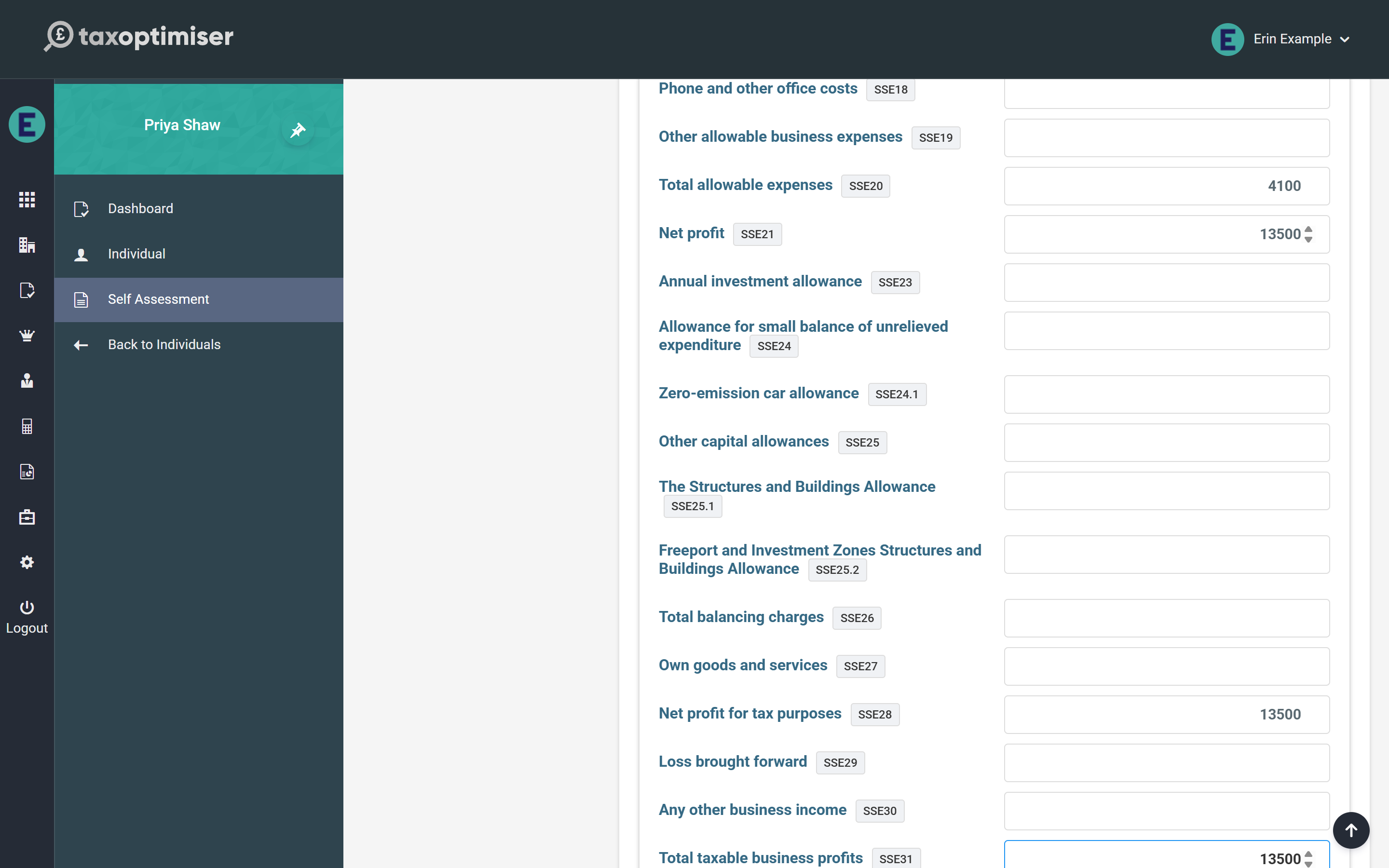
Enter the expenses in their categories, or — as HMRC permits a small business — the total alone. Where the categories are entered, the total box shows what they add up to with a Use this link.

The trading allowance (box 10.1 on the short page, 16.1 on the full) is claimed instead of expenses and capital allowances: up to £1,000 across all the client’s self-employment pages, never more than the profit it relieves, and never alongside an expense or capital-allowance box. The page warns in red the moment both are keyed, and HMRC would reject the return otherwise.
The profit chain
Enter the profit boxes as they appear on the accounts: net profit or loss, the adjustments, the adjusted profit and the total taxable profits box (31 short, 76 full) that flows into the tax calculation. The chain boxes show what the boxes feeding them come to, so a chain that does not add up is visible before HMRC sees it — and if a profit is keyed without the taxable-profit box, the calculation shows a note with the figure HMRC would expect, because HMRC taxes the taxable-profit box alone. A loss is entered as a negative figure in the profit box (it prints in the loss box of the paper form — 22, 48 or 65 — on the return preview and PDF).

National Insurance
- Class 4 is calculated on the taxable profit automatically. The exempt tick and the adjustment box cannot both be used on one page, and the exemption is one answer per person — a tick on any self-employment or partnership page exempts all of them, as HMRC’s rules require. A client with employment income has their Class 4 capped at the annual maximum when Class 1 earnings are entered on the employment page.
- Class 2 is charged automatically where profits are above the small profits threshold. Below it, tick voluntary Class 2 and Tax Optimiser writes the amount into the Class 2 box for you, pro-rated by the weeks the business traded when it started or ceased in the year; HMRC caps the box at £219.95 across all trading and partnership pages, and rejects the voluntary tick where profits are already above the threshold — the calculation says so.
Basis period reform: transition profits
Where the full page carries a transition profit spread (boxes 73.3 and 73.4), the calculation follows HMRC’s own treatment, which was confirmed against HMRC’s test service: the year’s slice is trading income of the year — it tapers the Personal Allowance, sits under dividends in the band stack, counts for student loan repayments and is charged to Class 4 — with one exception: it is left out of adjusted net income for the High Income Child Benefit Charge. The statement shows the slice on its own line so the position is clear.
Other rules the page keeps for you
Several HMRC caps are checked inline: the capital-allowance boxes cannot exceed £1.5 million, the short-page box 24 (goods for own use) is limited to £2,000, a loss set against other income cannot exceed the loss, and so on. Each shows under the box in red as you type, and the same rules run again in the pre-flight checks.
Next: UK property (SA105).
