
Open Employment (SA102) and press Add Employment for each job or directorship — a return can carry any number, each in its own card titled by employer name. Enter the pay and tax taken off from the P45 or P60, plus any benefits and allowable expenses, exactly as the paper SA102 lays them out.
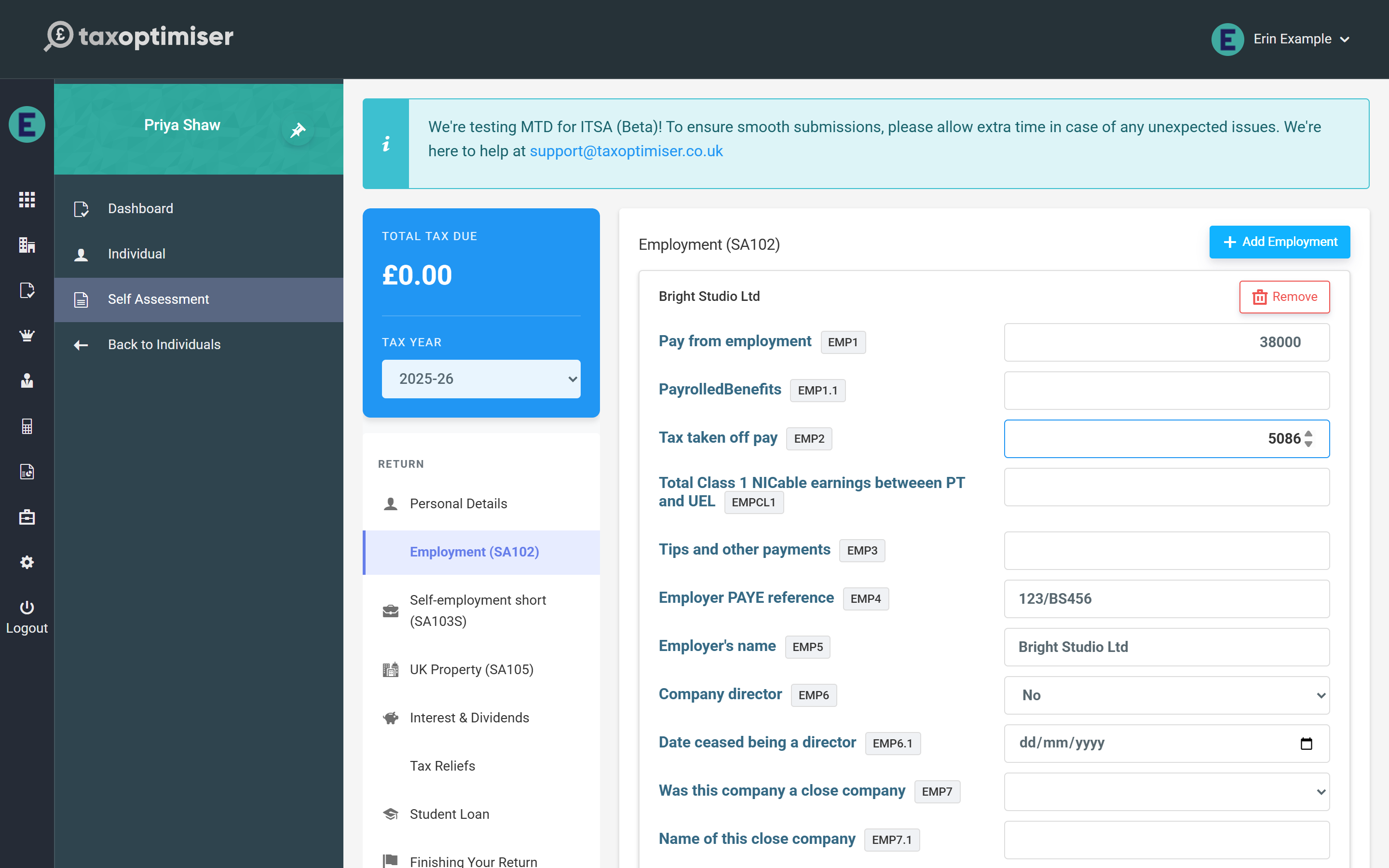
The two boxes every employment needs
HMRC rejects an employment page without the employer’s PAYE reference (box 4) and the company director answer (box 6). Both carry a Required chip; the director question is set to No on every new card, so a card needs only the PAYE reference before it is complete, and its header counts the required boxes still missing until then. Answering Yes to the director question opens the close-company boxes: whether the company is a close company (box 7) and, if so, its name, registration number, the dividends taken and the shareholding — HMRC requires those when box 7 is Yes, and the page says so if they are left empty. A directorship that ended in the year takes its end date in box 6.1, which must fall inside the tax year.

Pay, tax and the hints that matter
- Tax taken off (box 2) can be negative — a PAYE refund — but HMRC accepts that only when the return has another employment page, and across all employments the tax cannot exceed the pay. The hint under the box says so.
- Tips and other payments (box 1.1) are information only: they are already inside the pay in box 1 and are not added again.
- Dividends from a close company (box 7.3) are likewise information only — the dividend is taxed through box 4 of the main return, which must include it.
- Box 18 (fixed expenses deductions) is capped by HMRC at £1,132; the hint under the box says so, and the pre-flight checks refuse a higher figure before HMRC does.
- Class 1 earnings (EMPCL1) — the earnings between the primary threshold and the upper earnings limit on this employment’s P60. When the client is also self-employed or a partner, the calculation uses it to cap their Class 4 National Insurance at the annual maximum, the way HMRC does: the main-rate Class 4 band shrinks by the Class 1 already paid, and the rest of the profit is charged at the 2% rate. The calculation shows a note whenever it has done this.

Benefits and expenses
Benefits in kind go in boxes 9 to 16 exactly as the P11D shows them, and employment expenses in boxes 17 to 20. Each employment’s expenses are set against that employment’s pay; the calculation does not let one job’s expenses create a loss against another’s pay.
Several employments
When a client has more than one employment the cards are listed closed, each showing the employer and the pay, and open one at a time. Remove asks you to confirm before it deletes a card’s figures. A card with nothing keyed on it is not filed and does not count towards the number of employments HMRC is told about, so an empty card left behind does no harm — but a card with only the default “No” on it would be filed and then rejected for its missing PAYE reference, which is what the required boxes missing badge is there to catch.
Next year
When the next tax year is started from this one, each employer’s name and PAYE reference carry forward so the cards are ready to key; the pay and tax figures do not. A directorship that ended in the year rolls forward as a plain employment with the close-company boxes cleared.
