
Interest a company pays on money it borrowed for its trade is a trading expense, deducted from the trading profit like any other cost. Interest on money borrowed for anything else — buying shares in another company, buying a property to let, making an investment — is a non-trading loan relationship debit. It comes out of the trade and is set against the company’s interest income instead. When the debits are larger than the income, the company has a non-trading deficit, which it can set against its other profits. In Tax Optimiser, non-trade debits go in the Non Trade Debit section of the Corp Tax workspace. This guide explains which interest belongs there, how to fill in the grid, how a deficit is relieved (boxes 795, 260 and 263) and what Tax Optimiser leaves for you to decide.
Trading or non-trading?
The test is why the company borrowed the money, not who lent it or how it is labelled in the accounts. If the borrowing funds the trade — stock, equipment, working capital, premises the company trades from — the interest is a trading debit and stays in the trading profit. If it funds something outside the trade, the interest is non-trading:
| The loan paid for… | The interest is | In Tax Optimiser |
|---|---|---|
| Stock, equipment, the trading premises, day-to-day cash flow | A trading debit | Leave it in the trial balance — nothing to enter |
| Shares in another company | Non-trading | Non Trade Debit |
| A property the company lets out | Non-trading — a company’s borrowing costs are never a cost of its property business | Non Trade Debit |
| A loan the company has made, or an investment | Non-trading | Non Trade Debit |
Loan relationship debits are more than interest: they include loan arrangement fees and other costs of borrowing, discounts, exchange losses on foreign-currency debts, and a write-off of money the company is owed on a non-trade loan (except, generally, a loan to a connected company). All of them follow the same trading or non-trading test.
Rental property interest is the classic mistake. An individual landlord deducts mortgage interest in the property business; a company does not. If the interest nominal is marked UK property on the P & L section, Tax Optimiser shows a warning at the top of the Non Trade Debit section: set the line back to Trade on the P & L section, then enter the interest here.
Where the interest starts
Unlike interest received, interest paid is never picked up for you. Whatever the accounts format — “Other charges” on FRS 105 micro-entity accounts, “Interest payable and similar expenses” on FRS 102 — interest in the trial balance is part of the profit per accounts and is deducted as a trading cost. That is right for trade borrowing. For non-trade borrowing you move it with the grid.
Enter debits in Tax Optimiser
Open the accounting period’s Corp Tax workspace and choose Non Trade Debit in the left-hand menu.
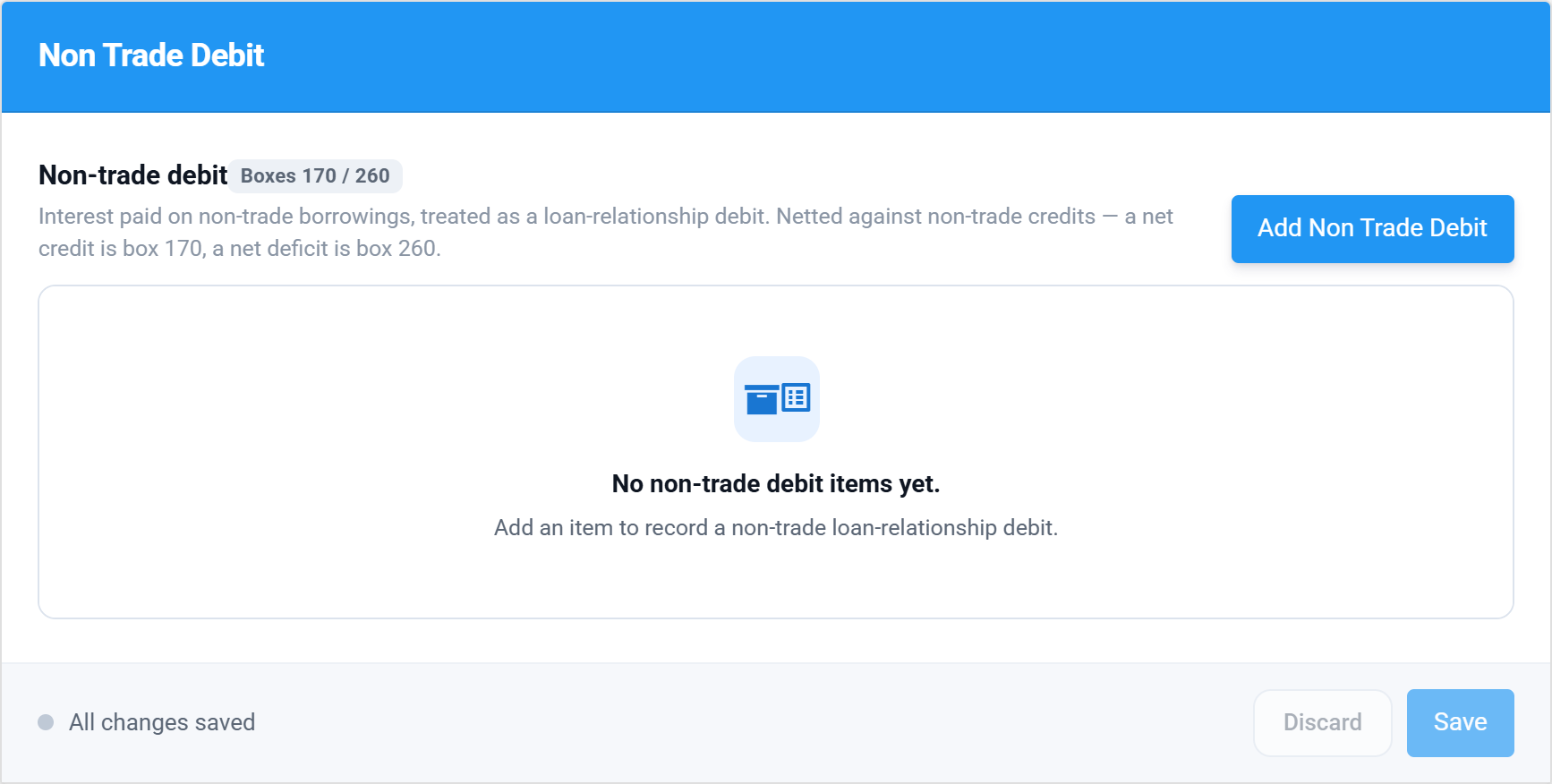
Choose Add Non Trade Debit and add one row per loan.
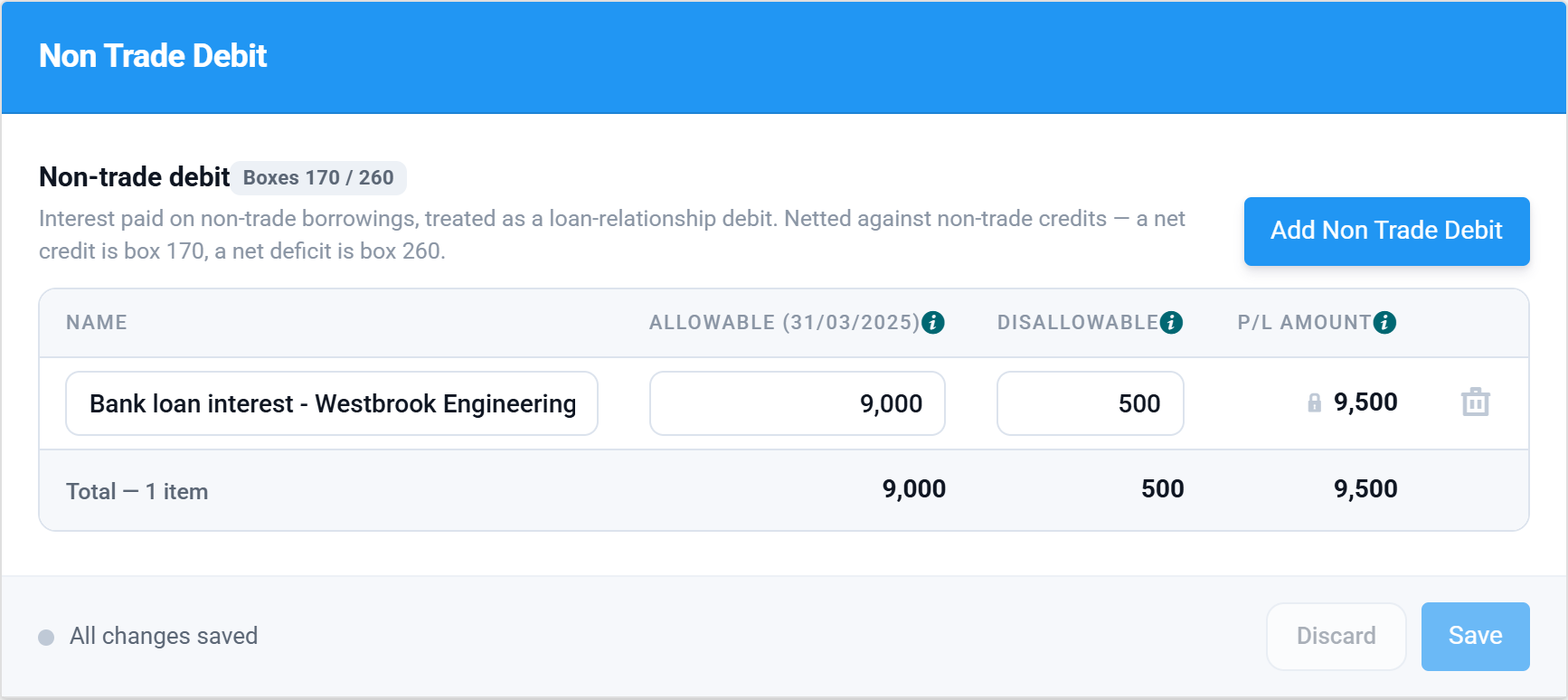
| Column | What goes in it |
|---|---|
| Name | The loan, and what it paid for. It prints on the computation. |
| Allowable | The debit that is relieved as a non-trade debit in this period. A period of account longer than 12 months shows an Allowable column for each return. |
| Disallowable | Any part of the debit that is not relieved at all — see below. |
| P/L Amount | Calculated: Allowable + Disallowable. The amount added back to the trading profit. |
For most loans the whole charge is allowable: enter the interest in the accounts in Allowable and choose Save. Because the P/L Amount is always Allowable plus Disallowable, the grid assumes the whole debit is in the profit and loss account.
What goes in Disallowable? Debits the loan relationship rules deny. The main one is the unallowable purpose rule: debits that are fairly attributable to a purpose that is not among the company’s business or commercial purposes (including a tax-avoidance main purpose) are not deductible at all. The disallowed part is added back to the trade with the rest of the P/L Amount but is not netted against credits.
What it does to the computation
- The P/L Amount is added back to the trade. It appears on the accounts adjustments page as “Non-trade loan relationship debits”, under disallowable expenditure.
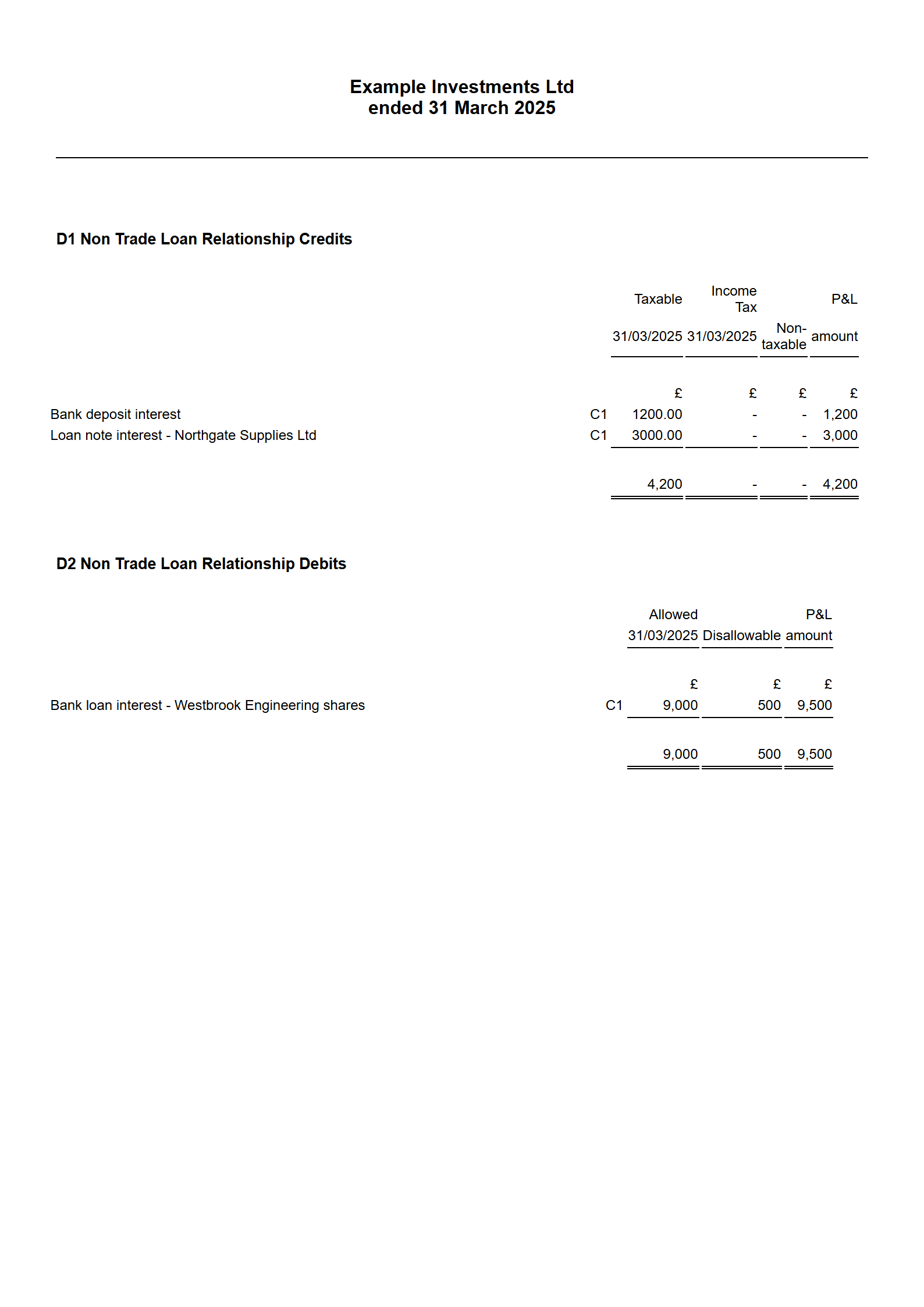
- The Allowable amount is netted against the credits — the Non Trade Credit grid plus any interest received that was picked up automatically.
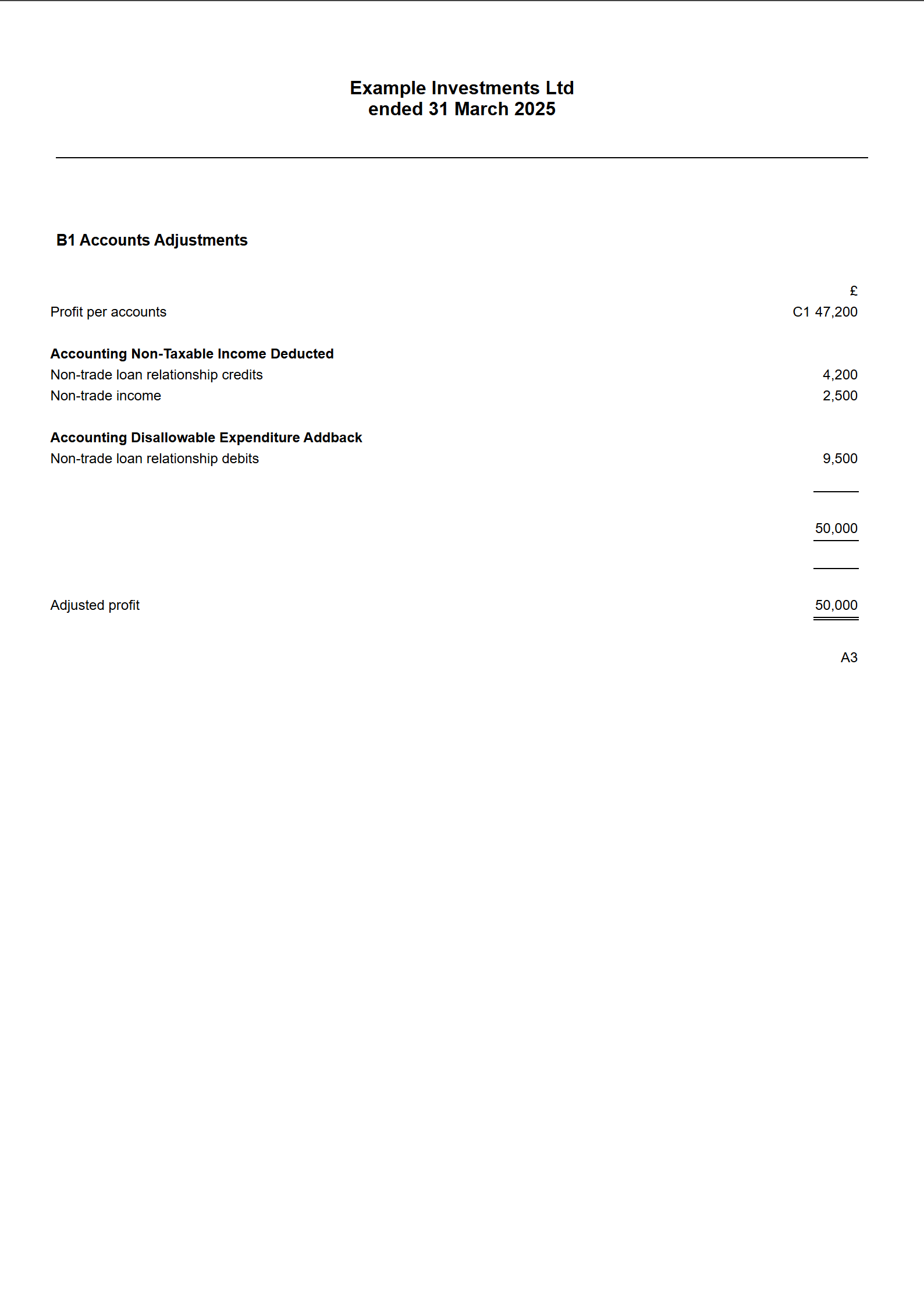
If the credits are larger, the net surplus is taxed in box 170 and there is no deficit. If the debits are larger, box 170 is nil and the difference is a non-trading deficit.
How a deficit is relieved
A non-trading deficit is reported in full in box 795 and then relieved, in this order:
- Against the total profits of the same period — box 260. Trading profits, property income, non-trade income and gains are all available, after any pre-April-2017 trading losses brought forward (box 160) and UK property losses (box 250). Tax Optimiser makes this claim for you whenever there are profits to absorb the deficit.
- Carried forward. Whatever box 260 cannot absorb is carried forward. Tax Optimiser shows the balance on the Losses section as Deficit carried forward.
- In a later period — box 263. A deficit brought forward is set against that period’s total profits after the current period’s own deficit. Enter it in the Non-trade Deficit B/F field on the Losses section of the later period.
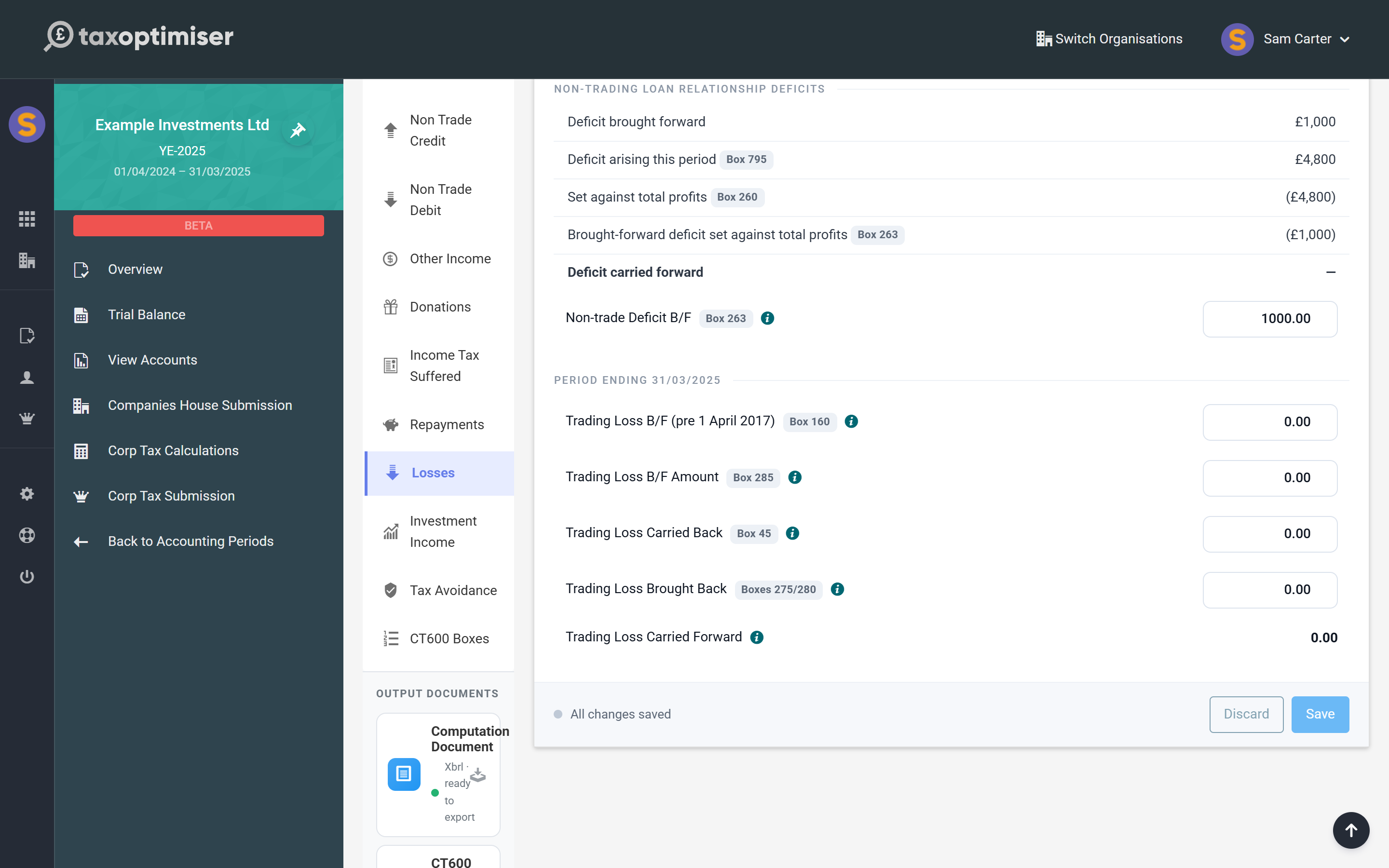
On a period of account longer than 12 months, the second return automatically brings forward whatever the first return could not use.
What Tax Optimiser does not decide for you
The deficit rules offer choices, and Tax Optimiser applies the default route above. If you want something different, it has to be dealt with outside the grid:
- Carrying a deficit back. Instead of a current-year claim, a deficit can be set against the previous year’s non-trading loan relationship profits. That amends the earlier return, which then shows box 170 net of the deficit and ticks box 172 — the Non Trade Credit guide explains how to enter it there. Tax Optimiser does not calculate the carry-back, and it still claims box 260 on this return for whatever the current profits can absorb, so reduce the Allowable figure here by the amount you carry back.
- Not claiming in the current year. The current-year claim is optional; without it the deficit simply carries forward. Tax Optimiser always makes it.
- Group relief. A deficit can be surrendered to another company in the same group. Box 800 (the maximum available for surrender) is left blank, and group relief claims are not calculated.
- Deficits from before 1 April 2017. These can only be set against later non-trading profits (box 230), not total profits. The Non-trade Deficit B/F field treats every figure as a post-2017 deficit relieved in box 263.
- Large companies. The corporate interest restriction (net interest over £2 million a year) and the restriction on carried-forward losses above the £5 million deductions allowance are not calculated.
- Late-paid interest. Interest owed to a connected party in some circumstances is deductible only when it is actually paid. Put any amount deferred this way in Disallowable and claim it in the year it is paid.
A claim to use a non-trading deficit is normally due within two years of the end of the accounting period in which the deficit arose, so decide before then.
A worked example
The screenshots come from a demonstration company, Example Investments Ltd, year ended 31 March 2025. It borrowed £150,000 from its bank to buy shares in another company, Westbrook Engineering Ltd, and the £9,500 of interest sits in “Other interest”, a cost inside the £47,200 profit per accounts. £500 of it relates to part of the loan the company used to fund an interest-free advance to a director, which is not a business purpose of the company, so that part is disallowable. The company also carried forward £1,000 of deficit from the year before.
| Step | Figure | Box |
|---|---|---|
| Trading profit, after adding back the £9,500 and taking out the credits and non-trade income | £50,000 | 155 |
| Non-trade income (an introducer fee) | £2,500 | 205 |
| Profits before other deductions and reliefs | £52,500 | 235 |
| Credits £4,200 less allowable debits £9,000 — deficit arising | £4,800 | 795 |
| Deficit set against total profits this year | (£4,800) | 260 |
| Deficit brought forward, set against total profits | (£1,000) | 263 |
| Profits before qualifying donations and group relief | £46,700 | 300 |
Box 170 is nil — a deficit is never shown as negative interest income — and Corporation Tax is £8,873.00 at 19%. Nothing is left to carry forward. The computation’s profits chargeable page shows the same netting:
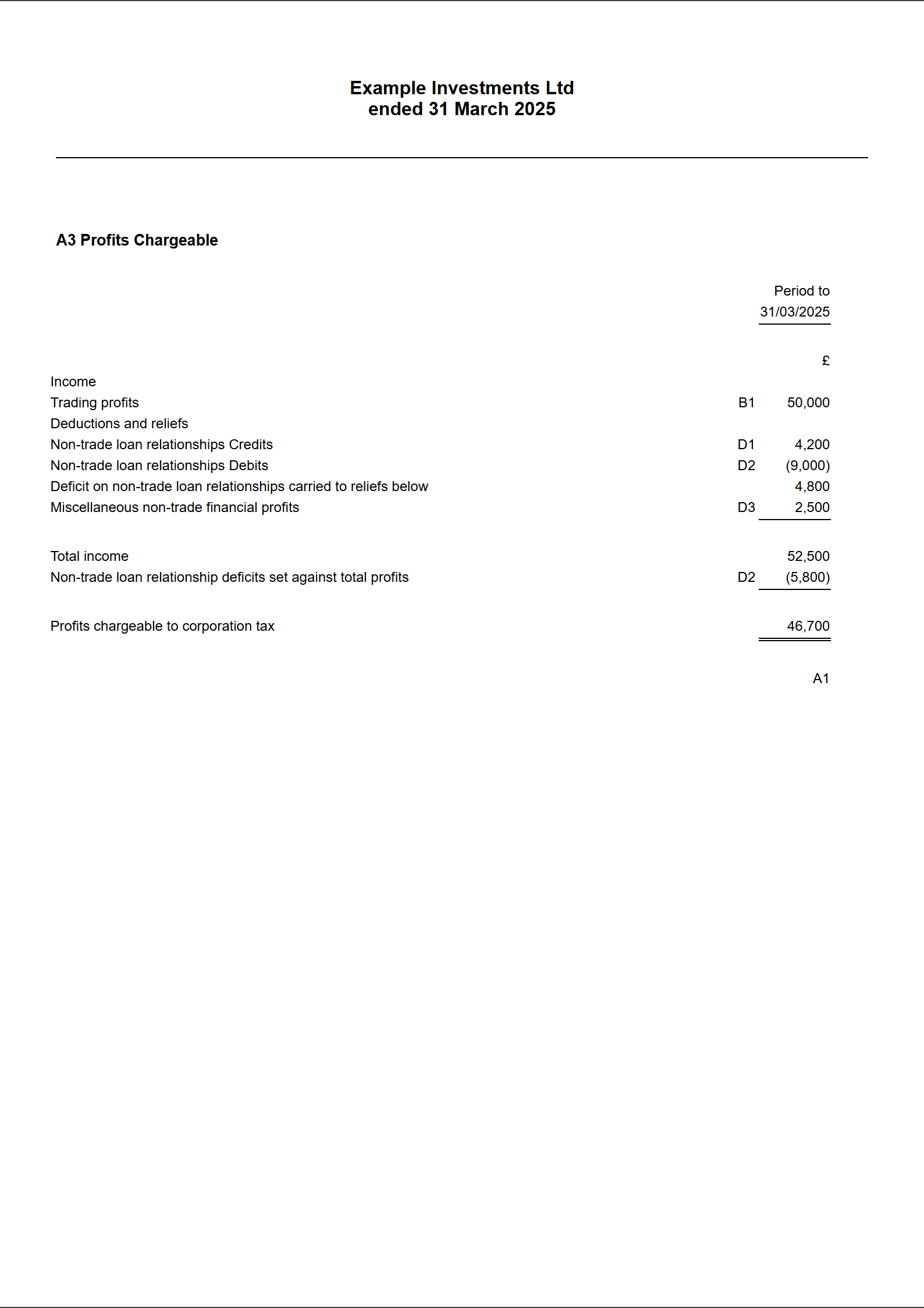
And the CT600 Boxes section shows the deductions:
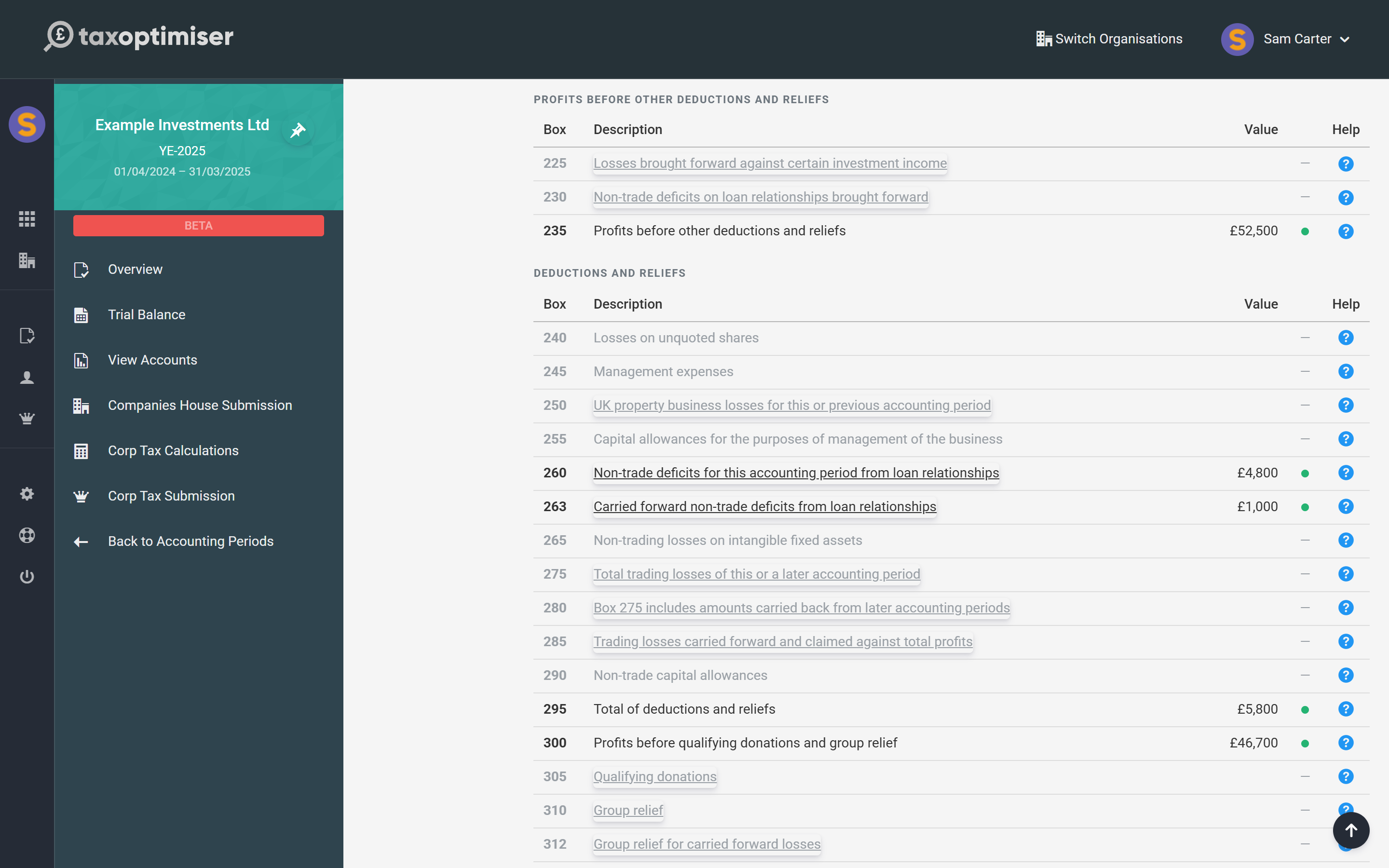
On the CT600 itself, box 795 is on the losses page:
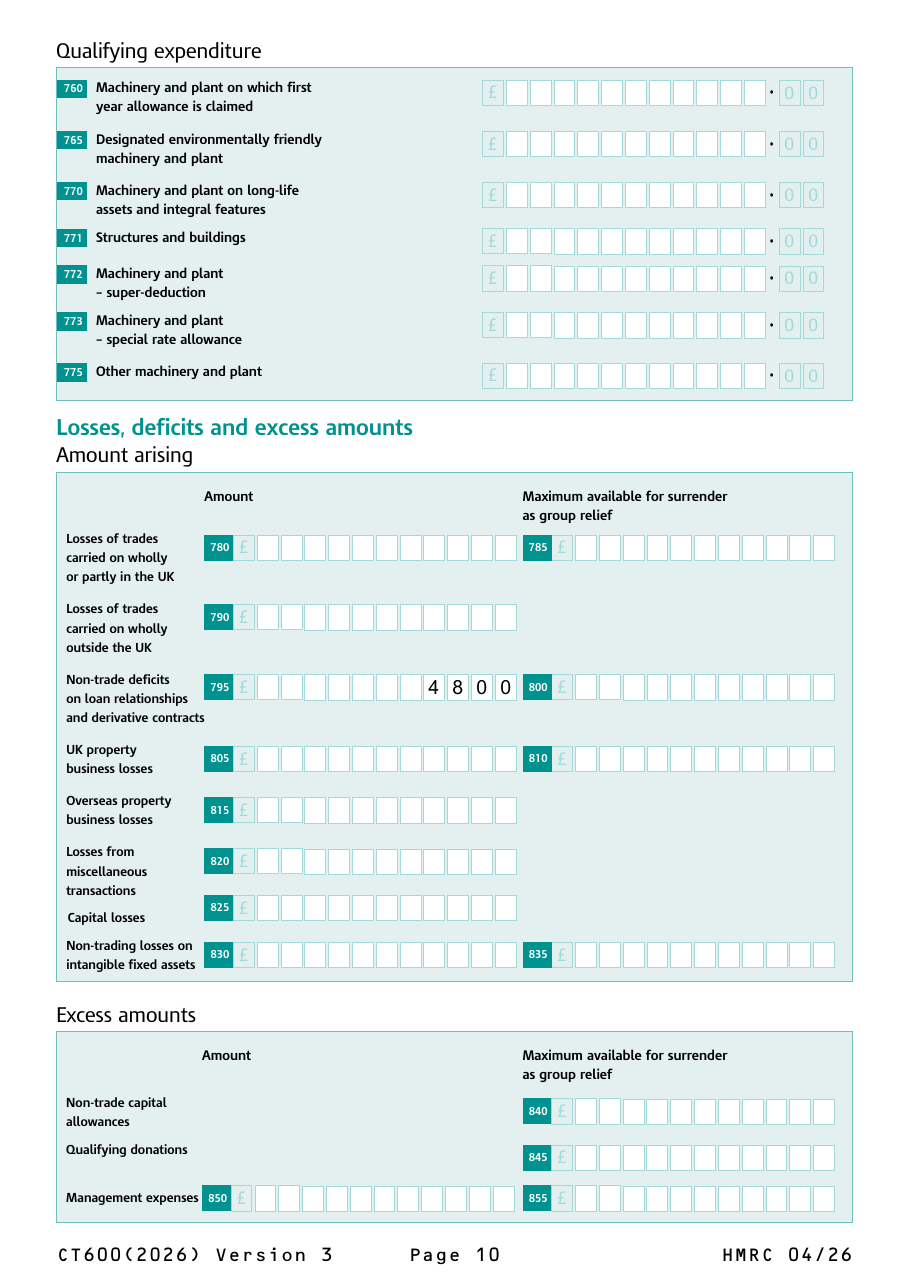
Things to check
- Trade borrowing stays in the trade. An overdraft or a loan that funds the business is a trading debit. Only move interest you can tie to a non-trade purpose.
- Interest typed UK property. A company’s property loan interest is a non-trade debit. Clear the warning by retyping the line as Trade on the P & L section and entering it here.
- P/L Amount matches the accounts. The P/L Amount is added back to the trade, so it must be the amount actually charged in the profit and loss account.
- Carry the balance forward yourself. Next year’s Non-trade Deficit B/F field is not filled in automatically — copy the Deficit carried forward figure into it.
- Charities. A charity claiming full exemption on its CT600E has no chargeable profits for a deficit to relieve, so boxes 260 and 263 are nil.
CT600 box by box
Box numbering follows the CT600 (2026) Version 3 form. Every other box is in the CT600 box-by-box guide.
Box 170 — Bank and other interest, and profits from non-trading loan relationships
The net surplus when non-trade credits exceed the Allowable column of this grid. When the debits are larger, box 170 is nil. The Non Trade Credit guide covers it in full.
Box 230 — Non-trade deficits on loan relationships brought forward
Pre-1 April 2017 deficits set against non-trading profits only. Not calculated by Tax Optimiser.
Box 260 — Non-trade deficits for this accounting period from loan relationships
The deficit arising this period, set against total profits, capped at the profits left after boxes 240 to 255 (so box 300 can never go negative). On a long period of account each return relieves its own deficit.
Box 263 — Carried forward non-trade deficits from loan relationships
Deficits from earlier periods set against total profits, after box 260 — from the Non-trade Deficit B/F field on the Losses section. On the second return of a long period of account it includes the first return’s unused balance.
Box 795 — Non-trade deficits on loan relationships: amount arising
The full deficit arising in the period — allowable non-trade debits less credits — before any relief. It is reported even when the whole amount is relieved in box 260 in the same year.
Box 800 — Maximum available for surrender as group relief
The part of the deficit the company could surrender to other group companies. Tax Optimiser does not calculate group relief and leaves this box blank.
Common questions
Is interest on a company loan to buy shares tax deductible?
Yes, usually — but not as a trading expense. Interest on borrowing used to buy shares is a non-trading loan relationship debit. It is netted against the company’s interest income and any excess is a non-trading deficit that can be set against the company’s other profits.
Can a company deduct mortgage interest on a rental property?
Yes, but not in the property business. For a company, interest on a loan to buy or improve a let property is a non-trading loan relationship debit, relieved against total profits through the non-trade rules rather than as a property expense. There is no restriction to basic-rate relief as there is for individual landlords.
What is a non-trading deficit?
The amount by which a company’s non-trading loan relationship debits — mainly interest on non-trade borrowing — exceed its non-trading credits, mainly interest received. It is reported in box 795 of the CT600 and can be set against other profits of the same period, carried back a year against non-trading profits, carried forward, or surrendered as group relief.
What is the difference between boxes 260 and 263?
Box 260 is this period’s deficit set against this period’s total profits. Box 263 is a deficit brought forward from an earlier period (after 1 April 2017) set against this period’s total profits. Box 260 is used first.
Why is box 170 blank when the company received interest?
Because the company’s non-trade interest paid was larger than the interest it received. Credits and debits are netted, and a net deficit is not shown as negative income in box 170 — it is reported in box 795 and relieved in box 260.
What goes in the Disallowable column?
Any part of the debit the rules do not allow, mainly amounts attributable to an unallowable purpose — a purpose that is not among the company’s business or commercial purposes. The disallowed part is added back to the trading profit but is not relieved anywhere.
Does Tax Optimiser carry a non-trading deficit forward automatically?
Within one period of account, yes: the second return of a long period picks up what the first could not use. Between accounting periods, copy the Deficit carried forward figure from the Losses section into the next period’s Non-trade Deficit B/F field.
Can a non-trading deficit be carried back?
Yes, against the previous year’s non-trading loan relationship profits, by a claim that amends that year’s return. Tax Optimiser does not calculate the carry-back: reduce the Allowable figure on this year’s return by the amount carried back, and on the earlier return reduce box 170 and tick box 172.
Where to go next
- Non-trade loan relationship credits and box 170 — interest the company receives.
- Non-trade income and box 205 — one-off income outside the trade.
- UK property income and losses — the rental business itself.
- HMRC’s Corporate Finance Manual — the detailed loan relationship and deficit rules.