
A company that holds investments — shares in subsidiaries, a portfolio of listed shares, loans — spends money running that investment business: accountancy, legal advice, administration, directors’ time. Those costs are not trading expenses, but they are still deductible. They are management expenses, deducted from the company’s total profits and reported in CT600 box 245. Capital allowances on equipment used to manage the investments are relieved the same way, in box 255. This guide shows how to set both up in Tax Optimiser.
What counts as management expenses
Any company whose business consists wholly or partly of making investments is a company with investment business. Its expenses of management of that business are deductible from total profits (CTA 2009 s1219). Typical examples:
- accountancy, audit and tax fees for the investment business;
- legal and professional fees for managing the investments (but not the costs of buying or selling them, which are part of their cost for chargeable gains);
- office costs, salaries and directors’ fees for the time spent managing the investments;
- bank charges and investment management fees.
Not included: capital expenditure, costs of a trade or a UK property business (which have their own computations), interest (a loan relationship debit — see Non-trade debits), and expenses with an unallowable purpose.
Many companies do both: a holding company might charge its subsidiaries for management services (a trade) and also manage its own shareholdings (an investment business). Only the investment-business costs are management expenses.
Step 1: enter the management expenses
Open Corp Tax Calculations and choose Management Expenses from the Sections menu. Enter:
- Management expenses in the P&L — the part of the profit and loss account’s expenses that are expenses of managing the investment business, for the whole accounting period.
- Excess management expenses brought forward — any management expenses from earlier periods that could not be relieved (CTA 2009 s1223). They are treated as management expenses of this period.
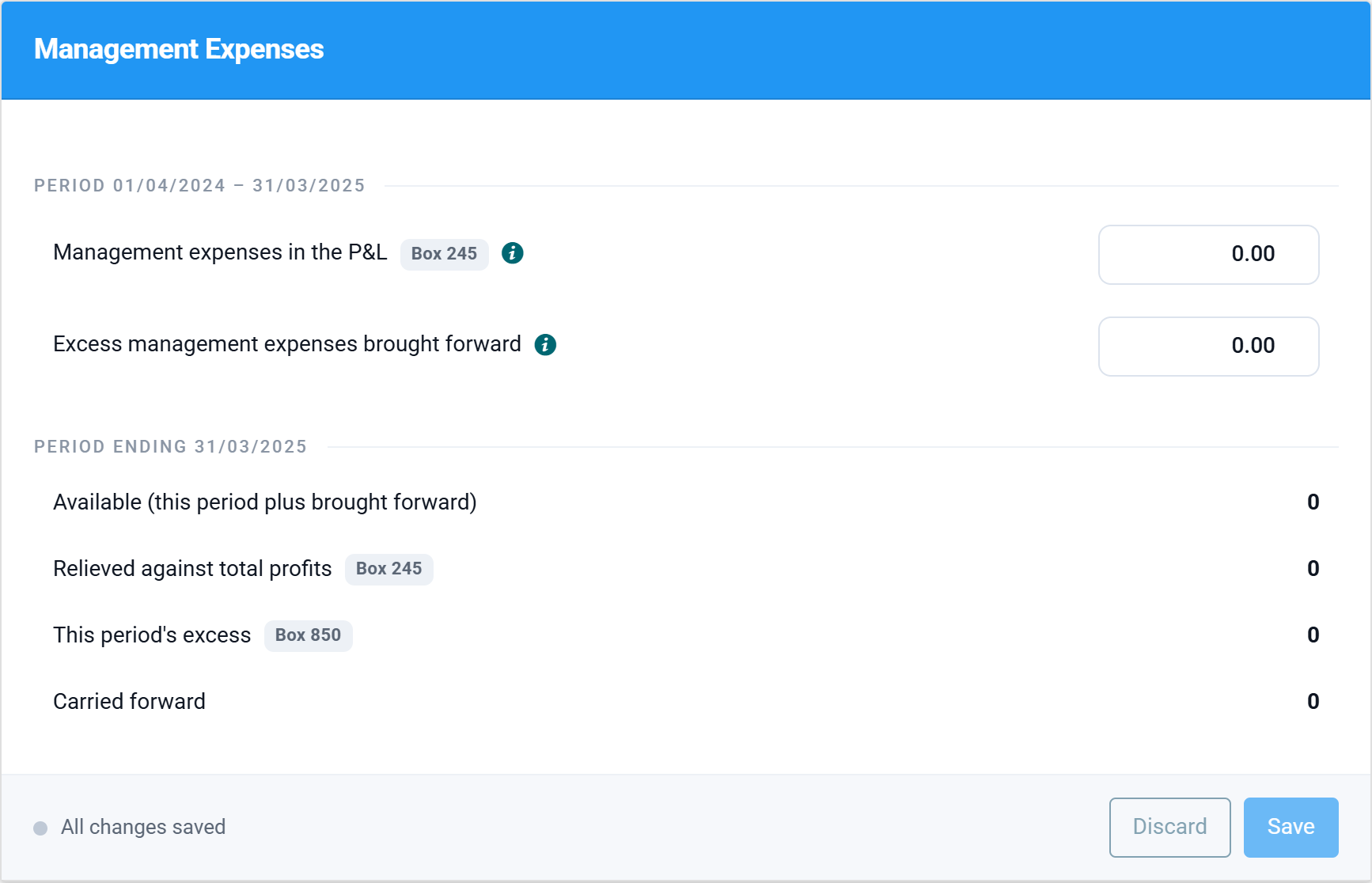
When you save, two things happen. The P&L figure is added back out of the trading profit as a “Management expenses” line in the accounts adjustments, so it is not deducted twice. Then the expenses are deducted from total profits in box 245, capped at the profits available. The section shows the result for each return period.
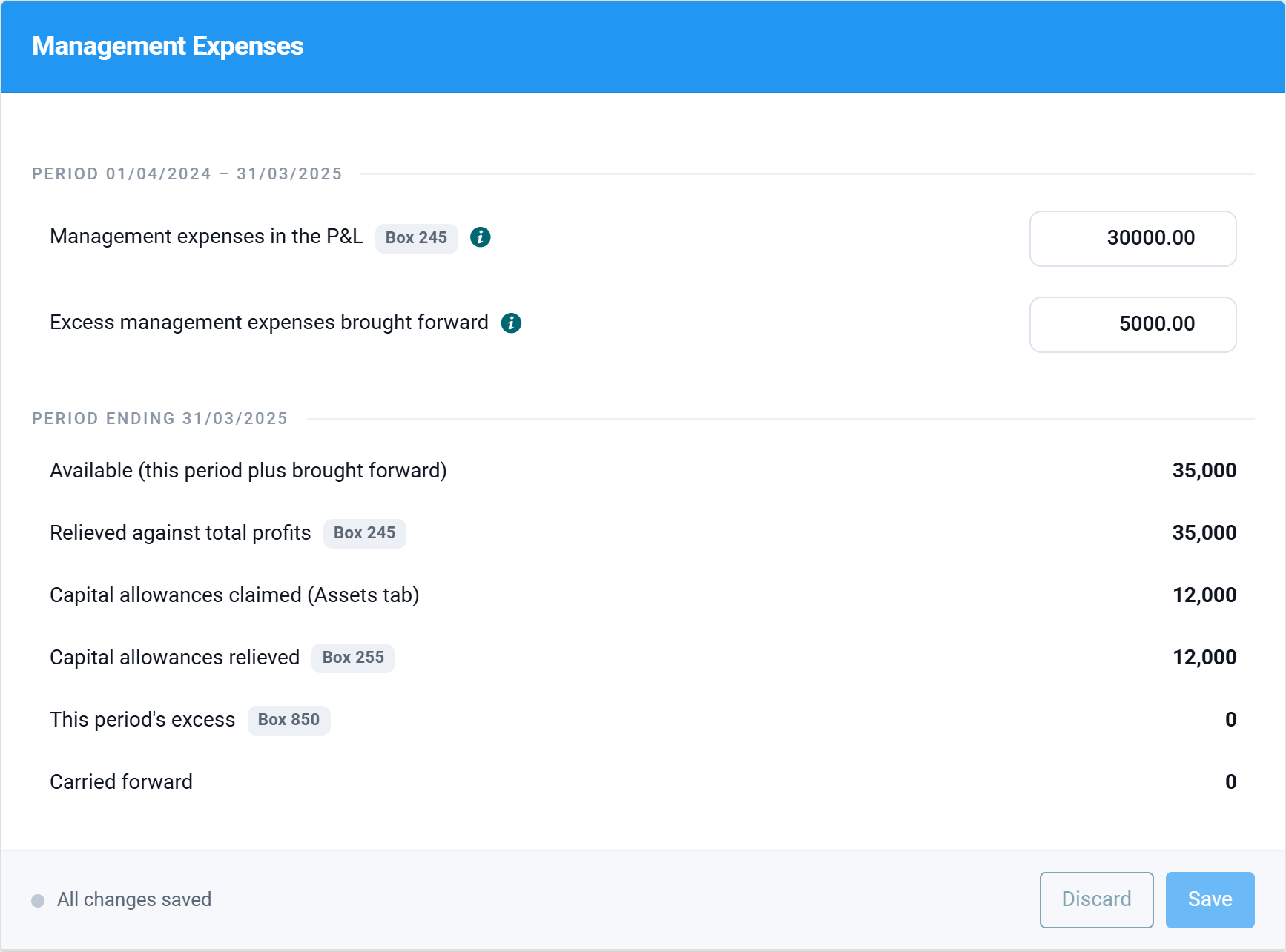
In the example, Example Holdings Ltd charges its subsidiaries £80,000 of management fees and spends £20,000 of directors’ salaries on that service — its trade. A further £30,000 of accountancy, legal and office costs relate to managing its own investments. Adding those back gives a trading profit (box 155) of £60,000, and the £30,000 plus £5,000 brought forward is relieved in box 245.
Step 2: capital allowances for the investment business
Equipment used to manage the investments qualifies for capital allowances, but those allowances are not a trading deduction either. They are given effect as management expenses (CTA 2009 s1233) and reported in box 255.
Record the assets in the Assets section as usual, then set Capital allowances claimed by at the top of the section to Investment business (management expenses). This option is never chosen automatically.
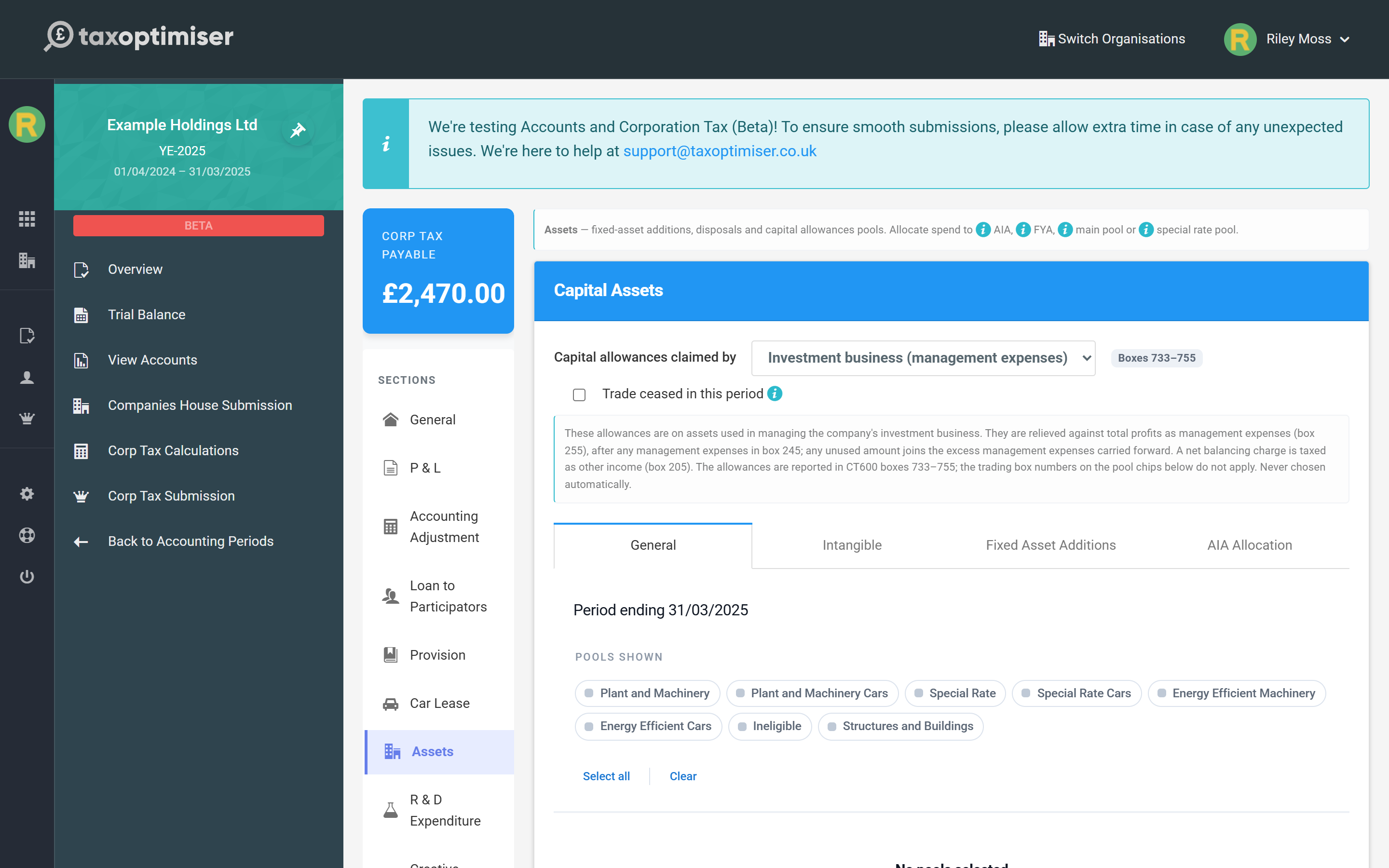
With that choice:
- the allowances no longer reduce the trading profit;
- they are relieved against total profits in box 255, after the management expenses in box 245;
- any allowances that cannot be relieved join the excess management expenses carried forward;
- a net balancing charge (more disposal proceeds than allowances) is taxed as other income in box 205;
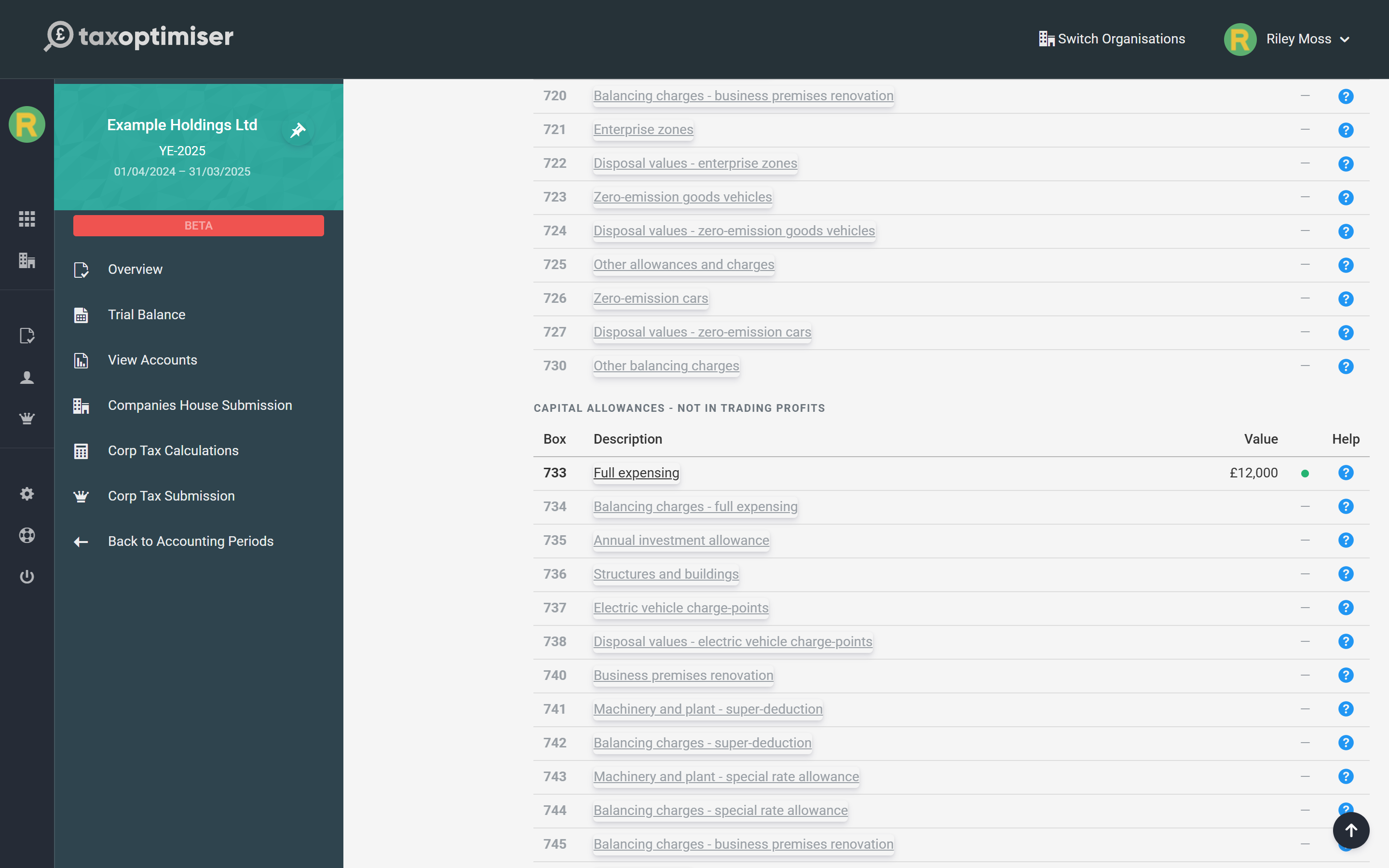
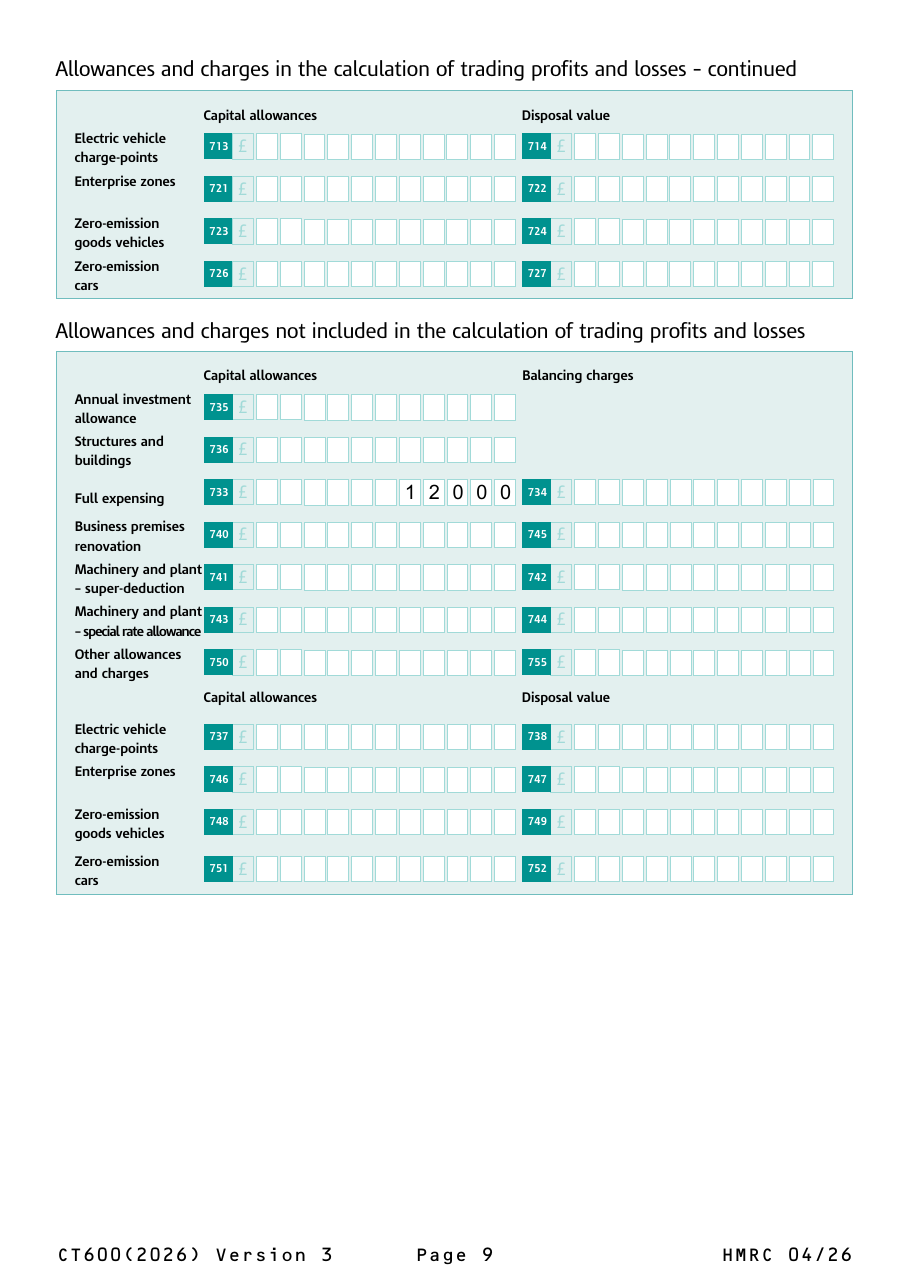
- the analysis boxes move from 688–730 to 733–755, the section for allowances not included in trading profits.
The depreciation add-back on the Assets section still comes off the trading profit, because the depreciation charge is in the P&L the trade starts from. Include only the management costs themselves in the Management Expenses figure.
A company can only send its capital allowances to one place — the trade, a UK property business or the investment business — for the whole period.
How the reliefs rank
Management expenses and their capital allowances come off total profits first, ahead of UK property business losses (box 250), non-trading loan relationship deficits (boxes 260 and 263), trading losses brought forward (box 285) and qualifying donations (box 305). Each later relief is capped at the profit the earlier ones leave. Management expenses never create a trading loss: once profits are used up, the rest carries forward.
Where it shows up
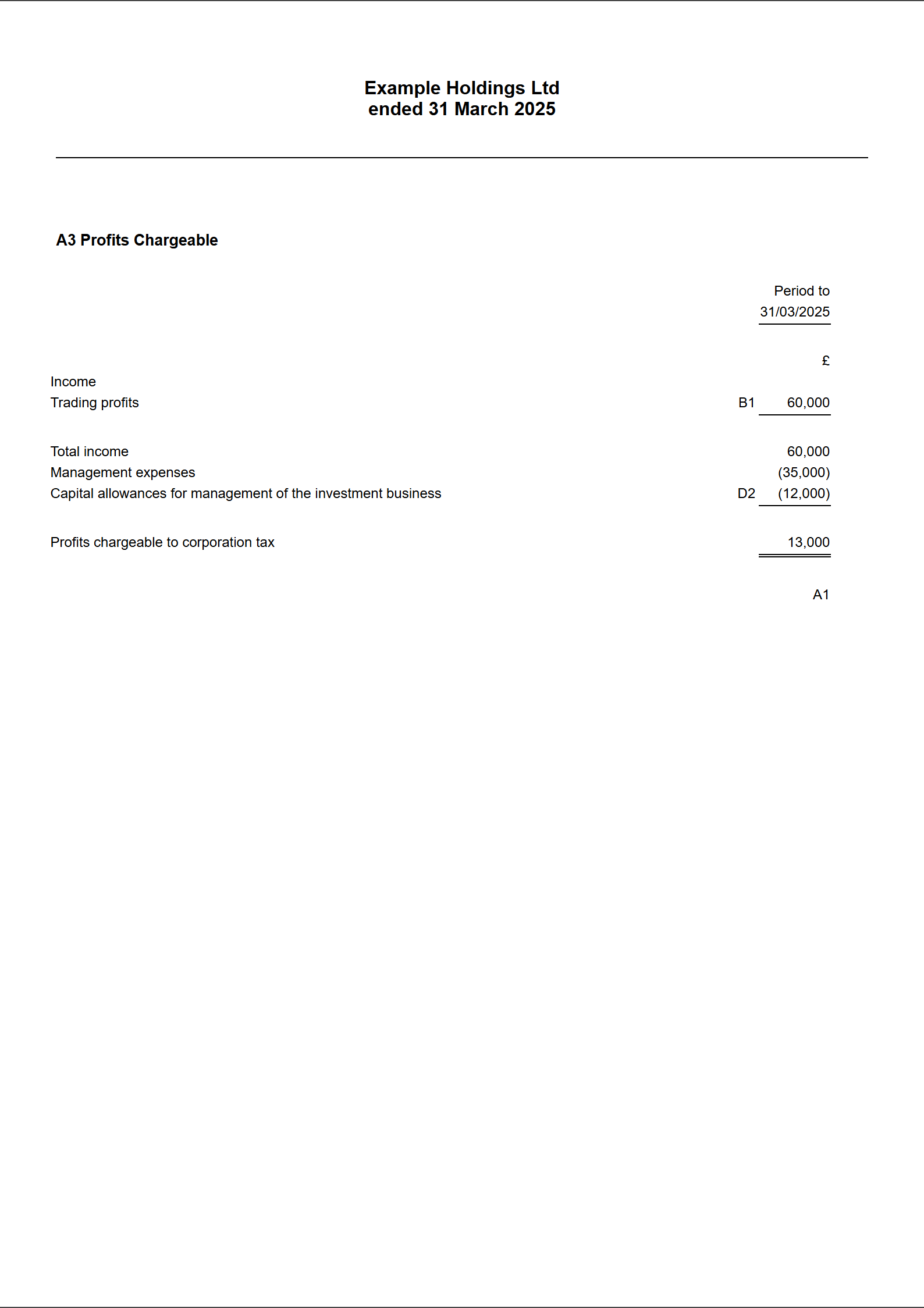
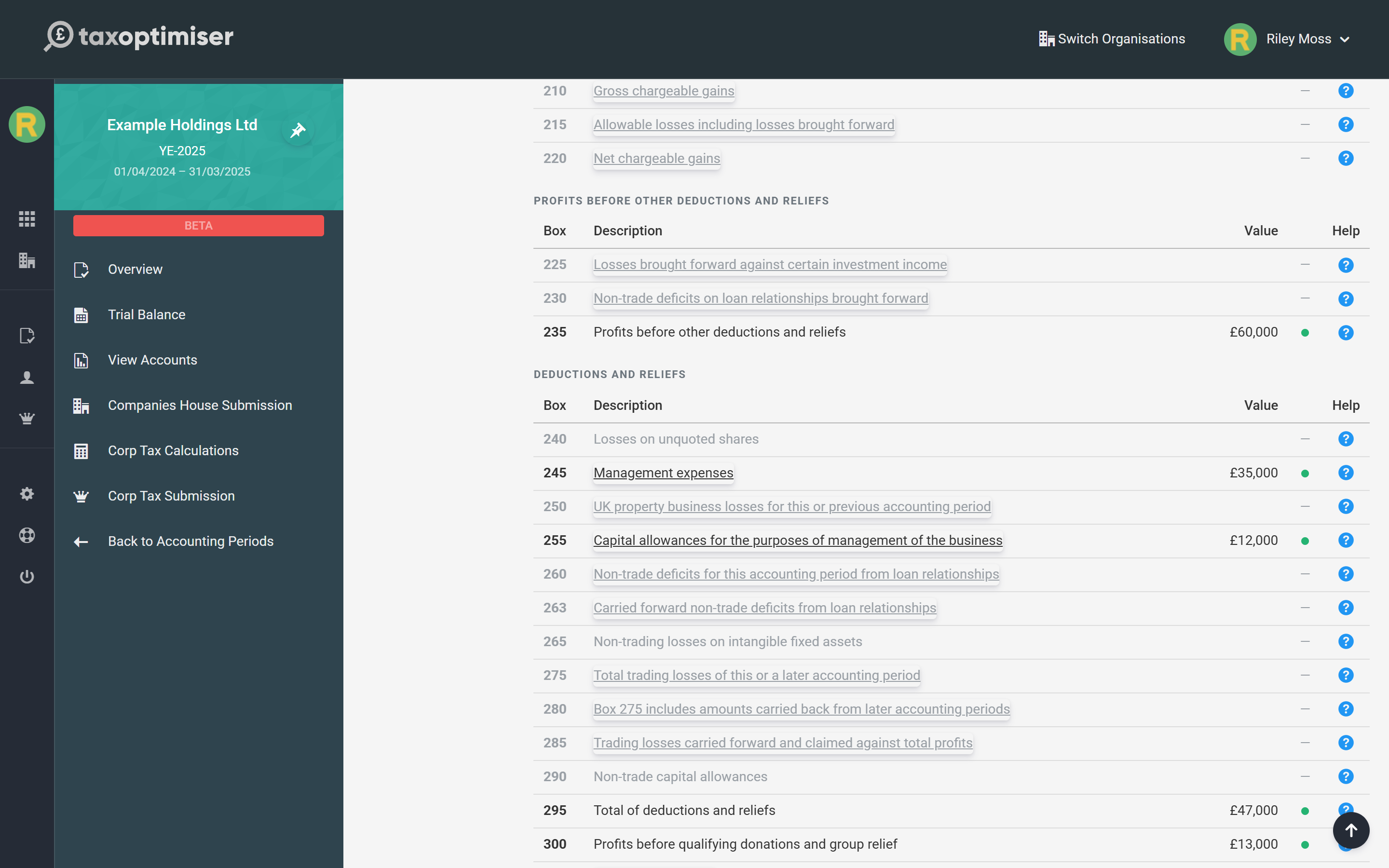
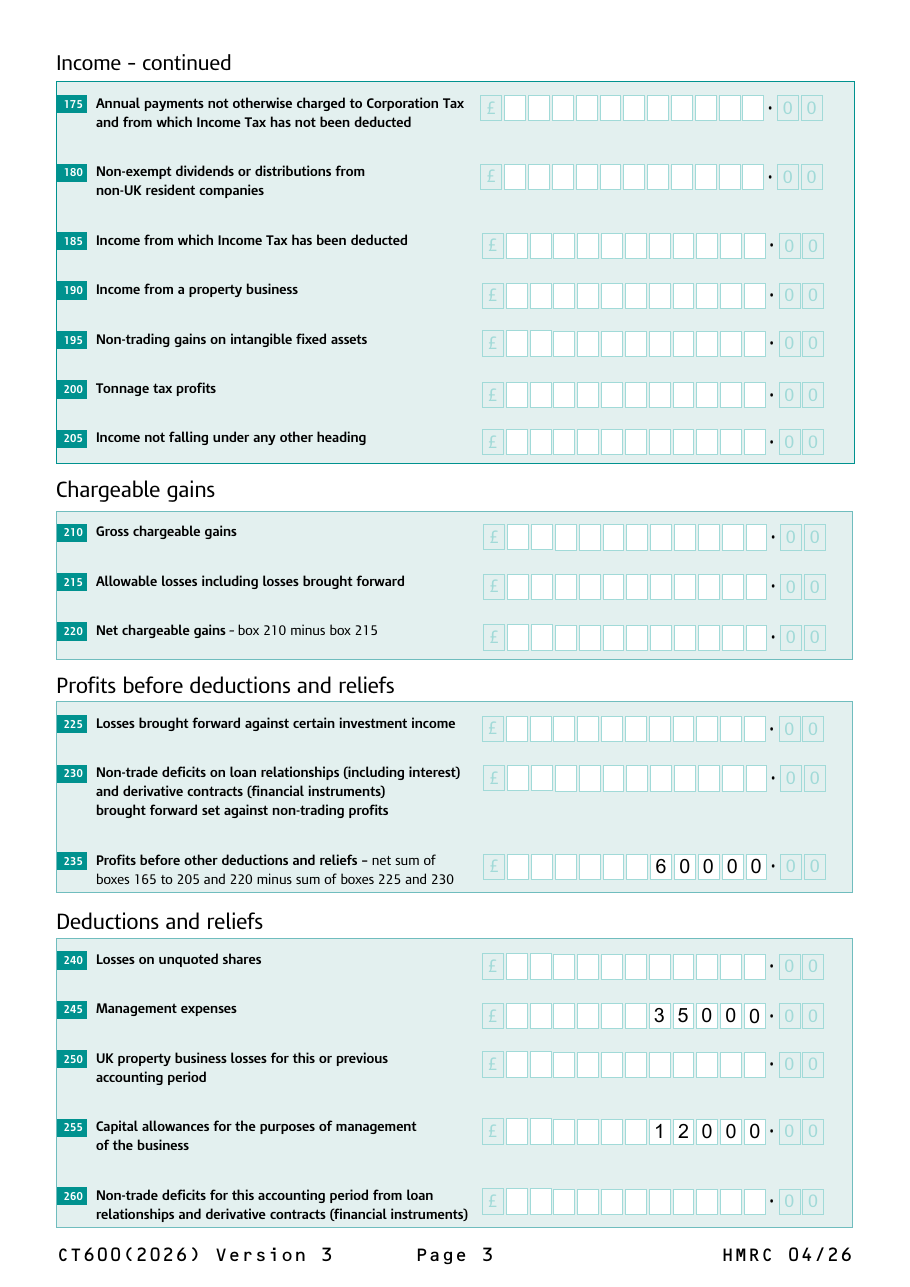
In the example the Corp Tax Payable headline is £2,470: £60,000 of total profits, less £35,000 in box 245 and £12,000 in box 255, leaves £13,000 taxed at 19%. The computation’s profits chargeable page shows both deductions.
The CT600 Boxes section and the CT600 itself show boxes 245 and 255 in the deductions, and the full expensing claim in box 733 rather than box 688.
When the expenses exceed the profits
Take an investment company with £20,000 of income, £80,000 of management expenses and £5,000 of excess brought forward. Box 245 is capped at the £20,000 of profits, so no tax is due. The period’s own unrelieved expenses, £60,000, are reported in box 850, and £65,000 carries forward (the £60,000 plus the untouched £5,000). The trading profit is unaffected and no trading loss is created. This period’s expenses are relieved before the amount brought forward.
On a return split into two periods because the accounts run longer than twelve months, the management expenses are apportioned by days and any excess from the first period passes to the second.
What Tax Optimiser does not do
- It does not decide which expenses are management expenses — enter the figure you have identified.
- It does not apply the restrictions on carried-forward management expenses after a change in ownership, or the £5 million deductions allowance restriction on brought-forward losses.
- It does not fill in box 855 (excess management expenses available for group relief). Surrenders are made on the CT600C.
CT600 boxes
Box 245 — Management expenses
This period’s management expenses plus the excess brought forward, relieved against total profits and capped at the profits available (box 235). Entered on the Management Expenses section.
Box 255 — Capital allowances for the purposes of management of the business
Capital allowances on assets used in managing the investment business, net of balancing charges, relieved after box 245. Filled when Capital allowances claimed by on the Assets section is set to Investment business. A net balancing charge goes in box 205 instead.
Box 850 — Excess management expenses
This period’s management expenses, including capital allowances for management, that could not be relieved. The amount carried forward also includes any unused excess brought forward.
Boxes 733 to 755 — Allowances not included in trading profits
The analysis of the investment business’s capital allowances: full expensing in 733, the annual investment allowance in 735, structures and buildings in 736, the super-deduction in 741, the special rate first-year allowance in 743, other allowances in 750 and balancing charges in 755. Boxes 688 to 730 are left empty.
Frequently asked questions
Can a trading company claim management expenses?
Only for an investment business it carries on alongside its trade. The costs of the trade itself are deducted in the trading profit as normal.
Why has my trading profit gone up?
Because the management expenses are taken out of the trade and deducted from total profits instead. The profits chargeable to Corporation Tax are the same or lower; only the analysis changes.
Can management expenses create a loss?
No. Relief is capped at the profits available. Anything left is excess management expenses, reported in box 850 and carried forward to the next period.
Where do I enter last year's excess management expenses?
In Excess management expenses brought forward on the Management Expenses section. They are treated as management expenses of this period.
How do I claim capital allowances for the investment business?
Record the assets in the Assets section and set Capital allowances claimed by to Investment business (management expenses). The allowances are then relieved in box 255 rather than in the trade.
Should interest on a loan to buy investments go in management expenses?
No. Interest is a non-trading loan relationship debit. Enter it on the Non Trade Debit section, where any deficit is relieved in boxes 260 and 263.
Where to go next
- Capital allowances: pools, additions and the AIA — recording the assets.
- Chargeable gains on the CT600 — when the investments are sold.
- CT600 box-by-box guide — every box on the main return.
- HMRC’s Company Taxation Manual — the management expenses rules (CTM08000 onwards).