
A company that bought a new electric van or lorry before 1 April 2025 could claim a 100% first-year allowance for zero-emission goods vehicles: the whole cost is deducted from its profits in the year of purchase. The claim has its own box on the CT600, box 723. This guide shows how to record the vehicle in Tax Optimiser and what to do with vans bought after the allowance ended.
The allowance and when it applies
The first-year allowance for zero-emission goods vehicles (CAA 2001 s45DA) covers vehicles built mainly to carry goods — vans and lorries, not cars — that cannot produce CO2 emissions when driven. The vehicle must be new and unused, and some businesses are excluded (HMRC’s Capital Allowances Manual has the conditions).
For companies it applies to expenditure up to 31 March 2025. HMRC removed box 723 from returns for accounting periods starting on or after that date. So the asset type matters for:
- returns for periods that started before 1 April 2025 — for most companies, the year to 31 March 2025 or earlier;
- amending an earlier return where a van was put in the wrong pool.
Zero-emission cars have their own 100% allowance (box 726), and electric vehicle charge-points theirs (box 713). Both are covered in Capital allowances: pools, additions and the AIA.
Vans bought from 1 April 2025
A new van is plant and machinery, not a car, so a company can still get a 100% deduction:
- Full expensing for new and unused main-rate plant bought from 1 April 2023 (box 688) — choose Full Expensing (100%);
- or the Annual Investment Allowance on Plant and Machinery, which also covers second-hand vans.
The practical difference from the old allowance is on sale: a full-expensing asset gives a balancing charge on its disposal value, whereas the zero-emission goods vehicle allowance put the van in the main pool.
Step 1: record the vehicle
Open Corp Tax Calculations, choose Assets and then Fixed Asset Additions. Click Add Asset, enter the name, the date and the cost, and choose Zero-Emission Goods Vehicle (100% FYA) as the pool.

In the example, Example Electric Deliveries Ltd bought two electric delivery vans for £52,000 in June 2024 and new warehouse racking for £8,000, claimed with full expensing. Both are deducted in full, so the £150,000 profit in the accounts becomes a trading profit of £90,000. Corporation Tax is £22,500 less £2,400 of marginal relief: £20,100.
The asset type only appears for accounting periods that start before 1 April 2025. If a vehicle dated on or after that day is given the type, the computation shows an error instead of a claim.
Step 2: check the CT600
The allowance is part of the main-pool first-year allowances in the computation, but on the return it has its own box: it is taken out of box 705 and reported in box 723. The expenditure is counted in box 760 with the other first-year allowance spending, and the racking goes in box 688.
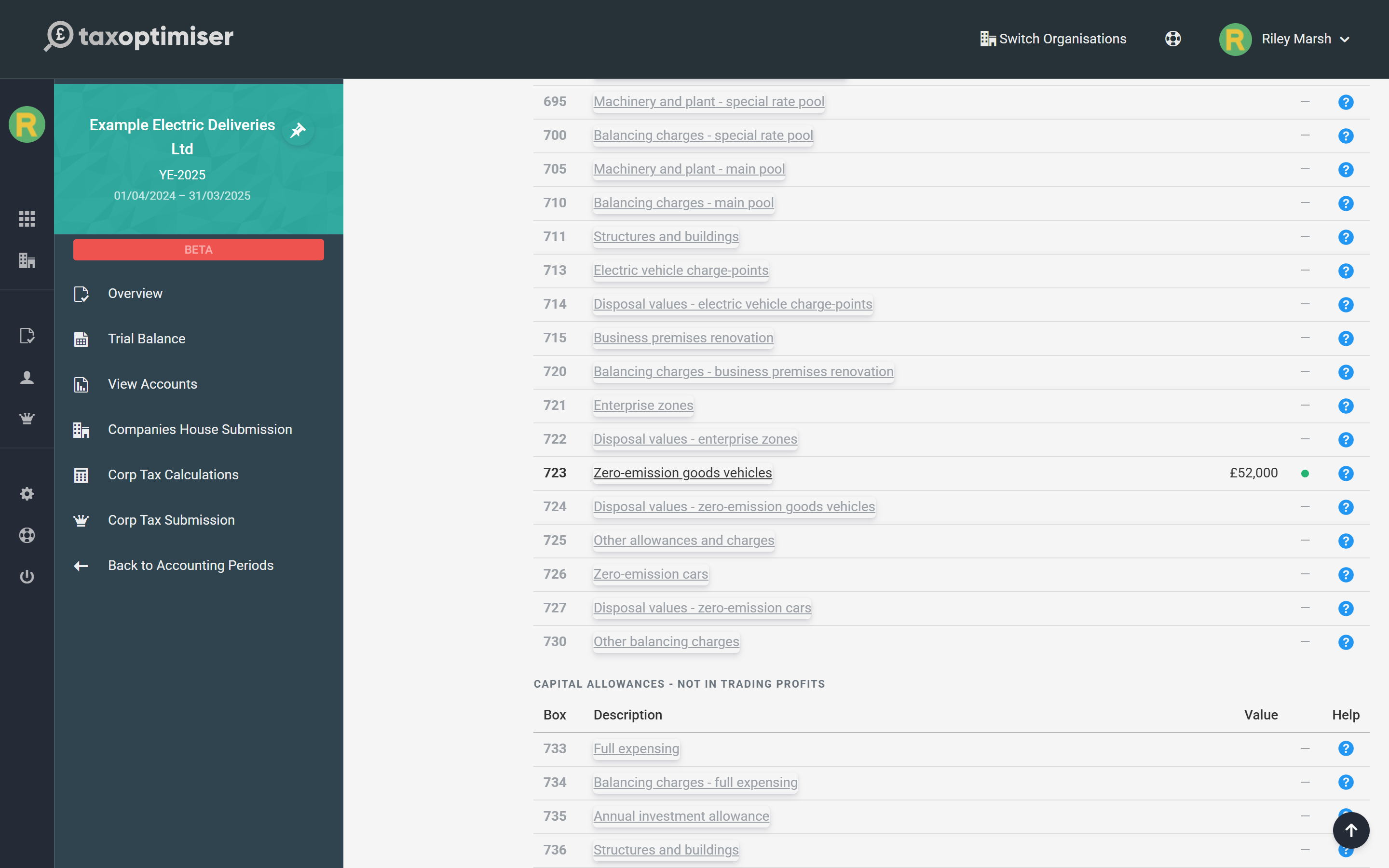
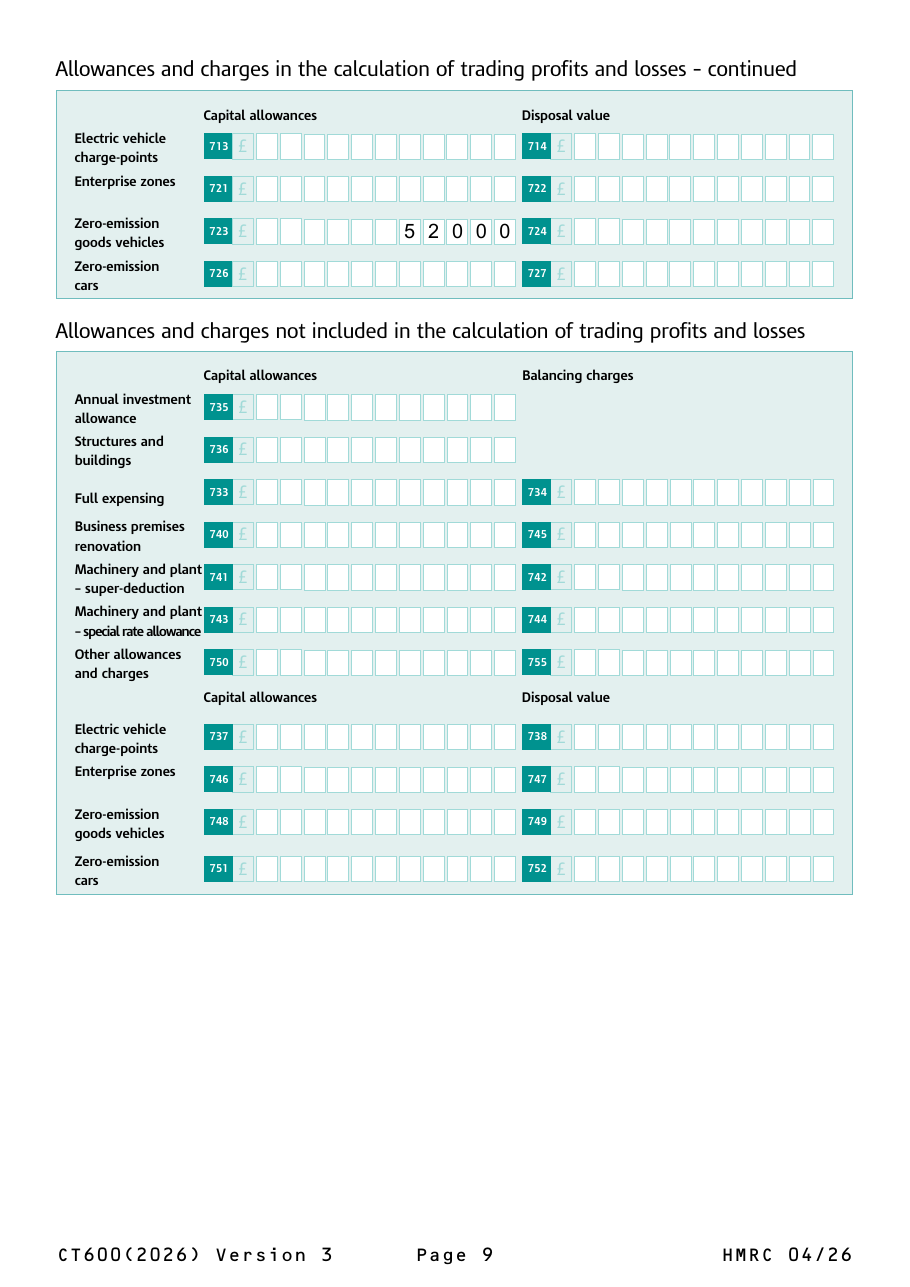
Tax Optimiser never drops a claim. If a return’s dates rule out box 723 but a vehicle is still recorded, its allowance stays in box 705.
Vans used in a property or investment business
When the Assets tab’s Capital allowances claimed by is set to the UK property business or the investment business, the allowances are reported in the not in trading profits section instead. Zero-emission goods vehicles then go in box 748, charge-points in box 737 and zero-emission cars in box 751. Only pool allowances with no dedicated box are left in box 750. See UK property income and losses and Management expenses for investment companies.
CT600 boxes
Box 723 — Zero-emission goods vehicles
The 100% first-year allowance on zero-emission goods vehicles in the trade. Only for accounting periods starting before 1 April 2025.
Box 724 — Disposal values of zero-emission goods vehicles
Tax Optimiser holds disposals at pool level, so this box stays blank; the disposal proceeds of a van are dealt with in the main pool.
Box 748 — Zero-emission goods vehicles not in trading profits
The same allowance where the capital allowances belong to a UK property business or an investment business. Also only for periods starting before 1 April 2025.
Box 749 — Disposal values not in trading profits
The counterpart of box 724; left blank for the same reason.
Box 760 — Machinery and plant on which first-year allowance is claimed
The total expenditure attracting any first-year allowance, including zero-emission goods vehicles, cars and charge-points, full expensing and the super-deduction — £60,000 in the example.
Frequently asked questions
Can I still claim 100% on an electric van?
Yes, if it is new: from 1 April 2025 a company claims full expensing (box 688) instead of the zero-emission goods vehicle allowance. A second-hand van can use the Annual Investment Allowance.
When did the zero-emission goods vehicle allowance end?
For companies, it covers expenditure up to 31 March 2025, and box 723 is only on returns for periods starting before 1 April 2025.
Is an electric car a zero-emission goods vehicle?
No. A car is not built mainly to carry goods. New zero-emission cars have their own 100% first-year allowance, reported in box 726.
Why is the Zero-Emission Goods Vehicle asset type missing?
It is only offered for accounting periods that start before 1 April 2025. For a later period, use Full Expensing (100%) or Plant and Machinery.
Where does the allowance go if the van is used in my property business?
In box 748, in the allowances not in trading profits, when Capital allowances claimed by is set to the UK property business.
Where to go next
- Capital allowances: pools, additions and the AIA — the Assets section in full.
- CT600 box-by-box guide — every capital allowances box.