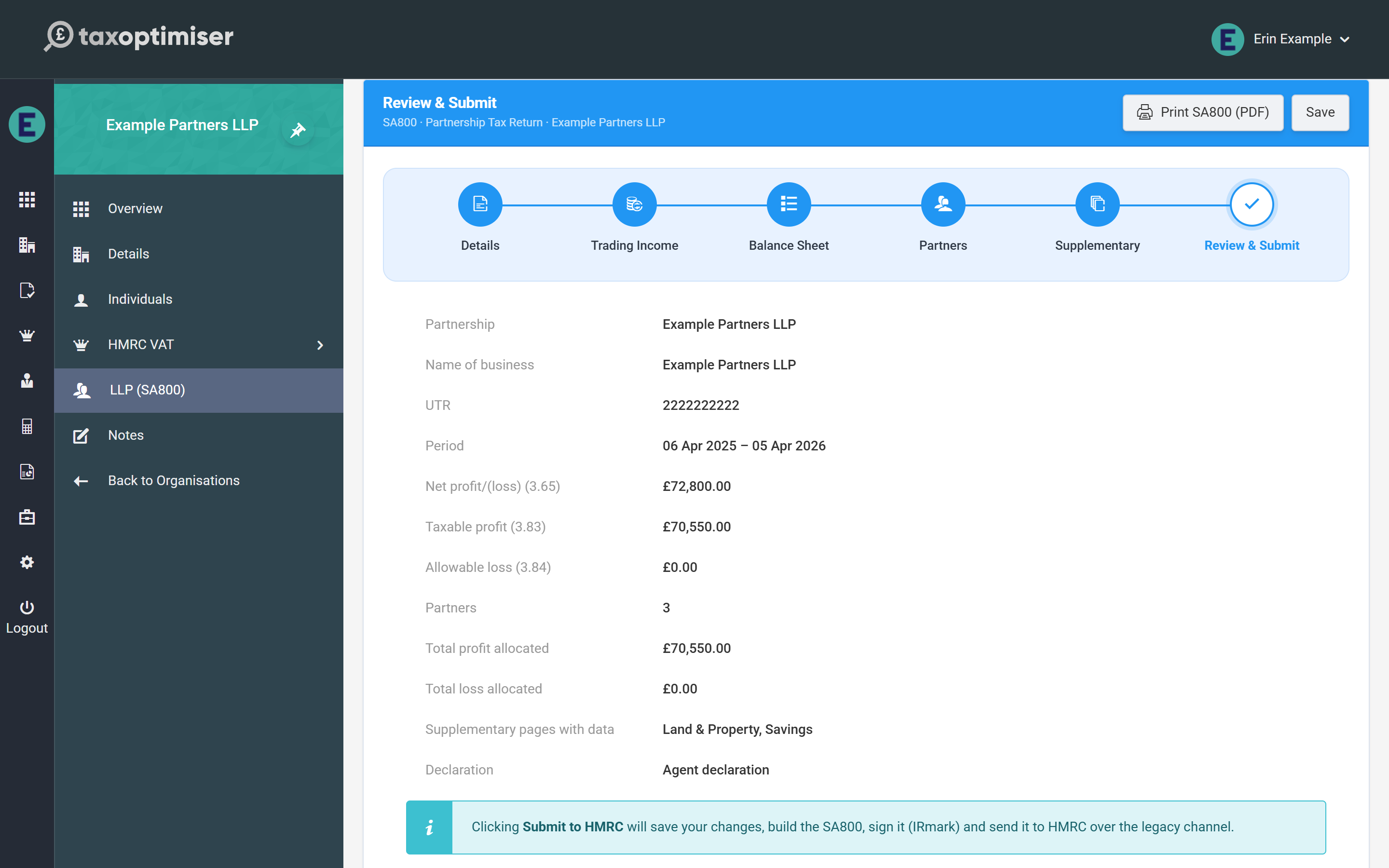
Tax Optimiser can now prepare and file the SA800 Partnership Tax Return for client partnerships — the annual return every UK partnership must send to HMRC, reporting the business’s income and how the profit was shared between the partners. You enter the return in a six-step wizard, the arithmetic boxes calculate themselves as you type, you can print the official SA800 form at any point, and you submit to HMRC without leaving Tax Optimiser.
Who this is for
The feature applies to client organisations whose structure is a Limited Liability Partnership or an ordinary Partnership — the LLP (SA800) menu section only appears for those organisations. The partnership itself pays no tax on the return: the SA800 reports the results and the Partnership Statement allocates them, and each partner then carries their own share onto the partnership pages of their personal return. If you also prepare the partners’ personal Self Assessment returns, Tax Optimiser’s Self Assessment (beta) feature covers those, including the SA104 partnership pages.
What is supported today
The beta supports the 2025-26 return with:
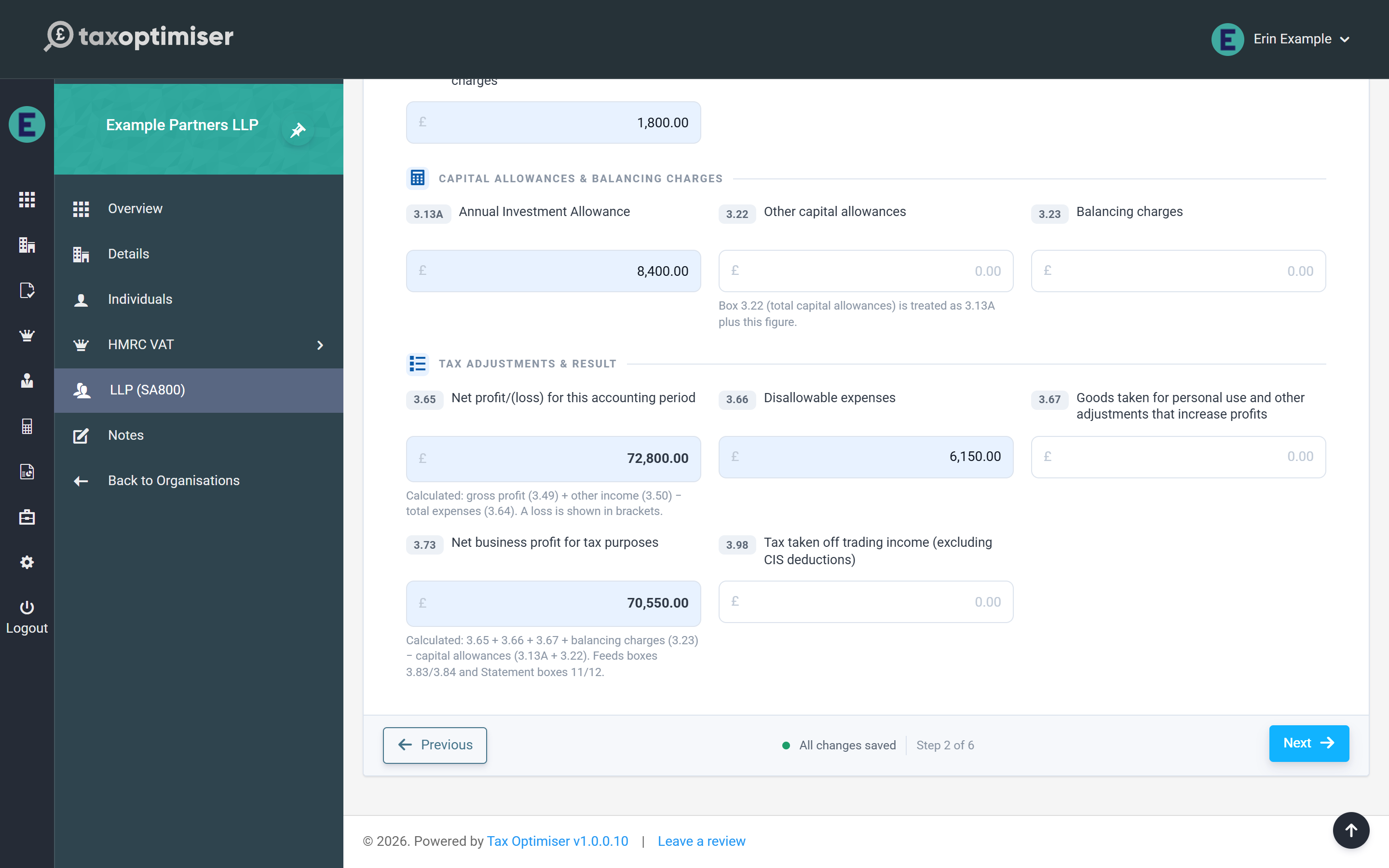
- The full trading income & expenses page (boxes 3.29–3.73) — also valid below the £90,000 three-line-accounts threshold, so one screen serves every size of partnership
- The summary balance sheet (boxes 3.99–3.115)
- The Partnership Statement — any number of partners, with each share checked against the return
- The supplementary pages: Land & Property (SA801), Foreign (SA802), Chargeable Assets (SA803) and Savings (SA804)
- Partner and agent declarations, and amended returns
- A populated, printable copy of the official SA800 form
- Direct filing to HMRC over their online channel, with the return signed and acknowledged end to end
Every calculated box on the form — net profit (3.65), net business profit for tax (3.73), the balance sheet totals, the partners’ closing balance — is derived for you and shown read-only, so the return can never disagree with its own arithmetic.
How the return comes together
The wizard walks the form in the order an accountant naturally works: partnership details, trading income, balance sheet, partners, supplementary pages, then a review step that summarises the whole return before anything is sent.