
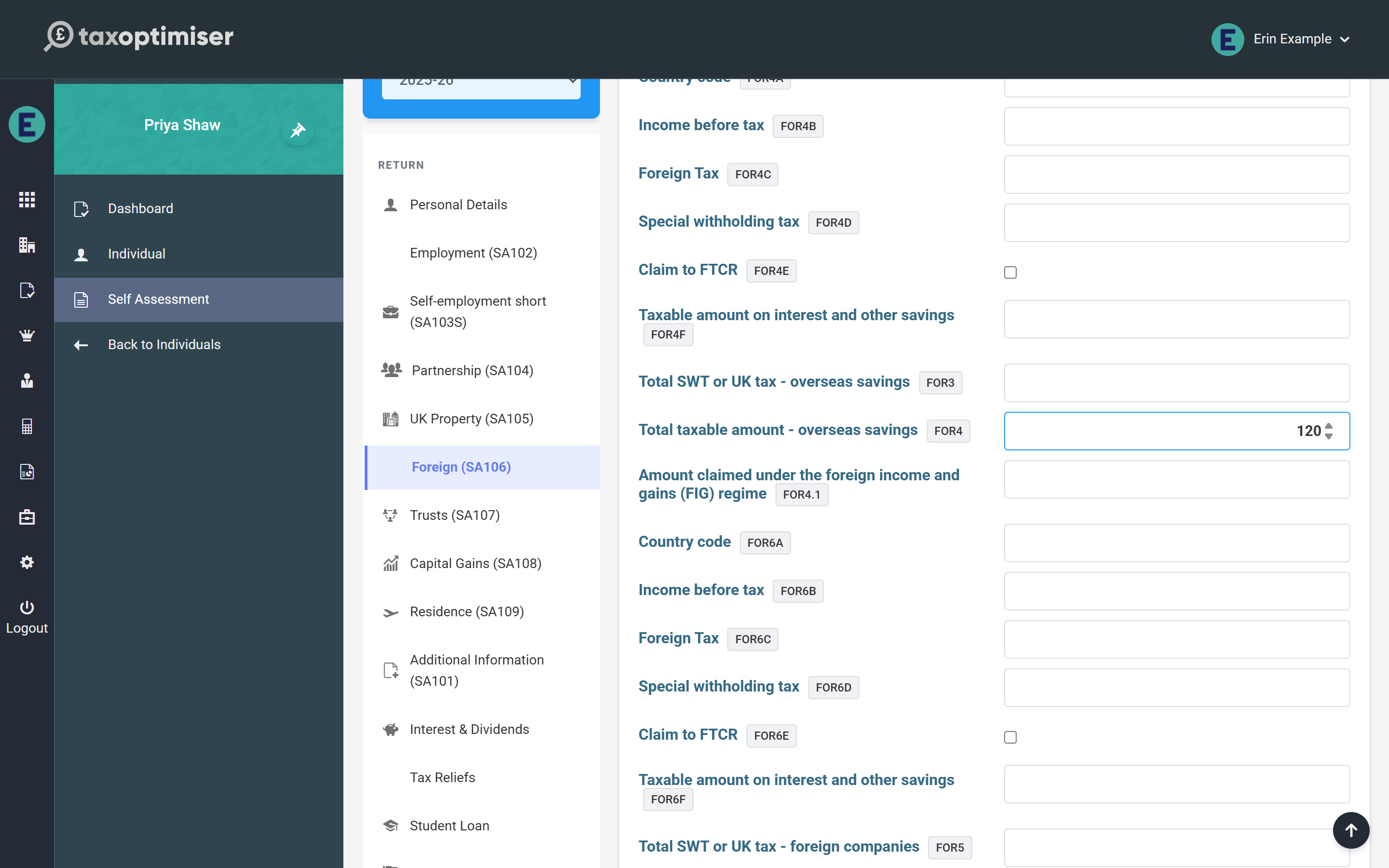
The Foreign (SA106) page takes overseas income by category — interest and other savings, dividends, pensions and social security, property, and other income — together with the foreign tax paid, any special withholding tax or UK tax already accounted for, and the claims for Foreign Tax Credit Relief. The remittance basis, the FIG regime and foreign gains have their own groups further down.
Income rows: columns A to F
Each income category is a row laid out like the paper form: the country code (A), the income before tax (B), the foreign tax (C), any special withholding tax or UK tax (D), the claim to Foreign Tax Credit Relief tick (E) and the taxable amount (F). Column F is the income less the foreign tax, or the gross income when relief is claimed in column E — the hint under each F box says which. Foreign tax in column C can never be more than the income in B, and a row needs a country code. The tax in column D is credited like tax deducted at source. HMRC files each income type by country, so every total needs at least one row with a country code beside it: a total keyed on its own is refused by HMRC’s schema, and the page says so under the country box (and in the pre-flight checks) until a row is added.
Foreign Tax Credit Relief
FTCR works as it does on the paper form: work out the relief on HMRC’s HS263 working sheet and enter it in box 2; it can be no more than the foreign tax on the rows whose claim box is ticked, and no more than the UK tax on that income. The calculation credits it up to the tax charged and notes that HMRC may recompute it. The page warns when box 2 is keyed with no claim ticked, when it exceeds the foreign tax claimed, or when a claim is ticked with no amount.

Overseas property
Overseas lettings follow the same shape as the UK property page: the number of properties (box 15, required when box 14 is keyed), income (14), the £1,000 property allowance (14.1, shared with the UK page’s box 20.1 and never alongside expenses), the traditional accounting tick (14.2, required above £150,000 and for a loss against general income), the expense boxes, and the chain to the taxable amount in box 30F, which is what HMRC taxes. A loss brought forward (box 26) must come off box 30F as well as box 27, and a loss beyond the year’s profit goes to box 32 for next year. Overseas residential finance costs (box 24.1) earn the same 20% reducer as UK property, with the unused amount carried to box 24.2. The calculation shows a note with HMRC’s figures for boxes 18 to 32 whenever the chain does not add up.
Gains, life policies and the remittance basis
- Foreign gains (boxes 33 to 38) are information only — the gain itself goes on the Capital Gains page. FTCR on gains (box 39), from the HS261 working sheet, comes off the Capital Gains Tax as keyed, capped at the CGT due and never against Income Tax; special withholding tax on gains (box 40) is repayable tax deducted.
- Foreign life-policy gains (boxes 43 to 45) are taxed at the top of income with top-slicing relief over the years in box 44; box 45 (the notional basic-rate tax) must be less than the gain.
- Remitted income (boxes 7.1 to 7.5) is taxed as non-savings income without the savings or dividend allowances; the box 7.5 dividend part is grossed up and its credit is non-repayable, as HMRC applies it.
- Each FIG regime claim box (the .1 boxes beside the income) can be no more than the income it sits beside; a claim takes that income out of charge but costs the Personal Allowance and other allowances — see Residence.
What this page does not cover
Every box on the Foreign page is calculated and files online, including income from non-resident settlor-interested trusts (boxes 48 to 57) and Transfer of Assets Abroad charges and benefits (boxes 46 and 58 to 64) with their FIG claims; each treatment was confirmed against HMRC’s own test service. The one remaining limit is structural: each income group holds a single row, and there is one overseas property. A client with the same kind of foreign income from more than one country, or with more than one overseas property, cannot yet be filed correctly from this page.
Next: Trusts and estates (SA107).
